
A house-price index slows, yet a buyer’s monthly budget becomes tighter. There is no contradiction: purchase prices are only one input into affordability. Borrowing costs, deposit size, income, taxes, insurance, and maintenance can all change the household calculation.
House Prices: At a glance
- An index tracks price movement under a defined methodology.
- A mortgage payment depends on principal, rate, and term.
- Affordability needs a household budget, not just an index headline.
What an index leaves out
A house-price index is useful for studying market changes, but it is not a quoted price for a particular home. Coverage and methods matter. A repeat-sales index, for example, answers a different statistical question from a raw median of all homes sold in a month.
The CFPB’s Loan Estimate explainer separates loan terms, estimated payments, and closing costs. That structure shows why affordability cannot be inferred from a price index alone. Read each component of the actual offer and expected ownership costs.
A fictional payment comparison
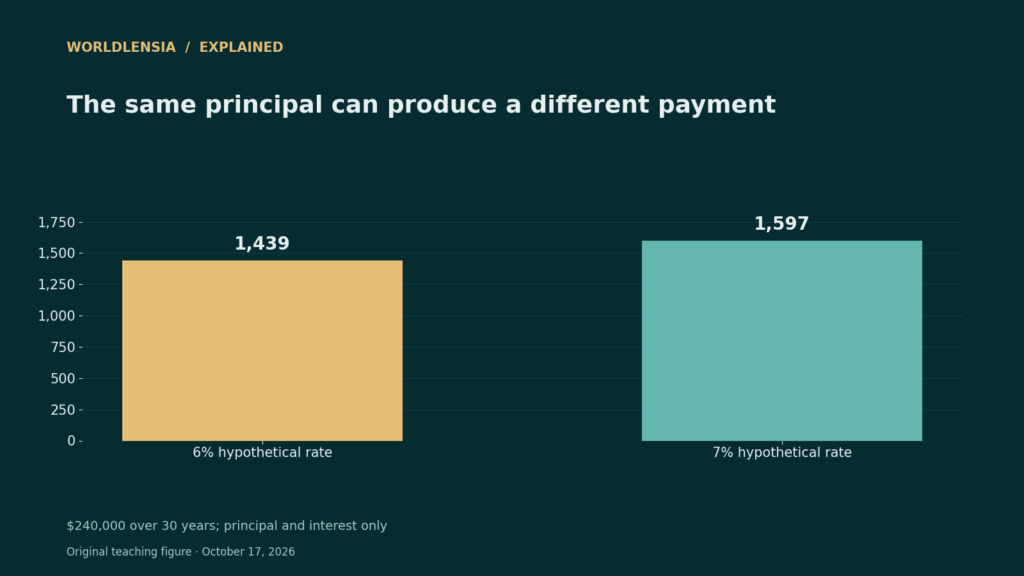
Consider a $240,000 fully amortizing fixed-rate loan over 30 years, with monthly payments and no fees financed. Using the standard payment formula, principal and interest are approximately $1,439 at 6% and $1,597 at 7%. That is about $158 more each month at the same principal.
These are hypothetical rates, not current offers. The calculation excludes property tax, insurance, mortgage insurance, association fees, utilities, and maintenance. It illustrates interest-rate sensitivity while keeping other inputs constant. A real comparison should use the loan’s actual payment terms and rounding.
Build a decision sheet
Start with the property price and down payment, then record the proposed loan amount, term, rate, closing costs, and all expected monthly housing expenses. Add a realistic maintenance allowance and check how variable costs could change.
Compare that budget with dependable household income and other commitments. A national affordability statistic can provide context, but it cannot determine whether a particular household can sustain a specific purchase. Keep the market indicator and the personal budget as related but separate analyses.
A practical comparison
| Fictional 30-year loan | 6% rate | 7% rate |
|---|---|---|
| Principal | $240,000 | $240,000 |
| Monthly principal and interest | About $1,439 | About $1,597 |
| Other ownership costs | Excluded | Excluded |
Before using the result
- Identify what the index measures.
- Hold inputs constant when testing one variable.
- Include non-mortgage ownership costs in the real budget.
Continue exploring: more real-estate data guides.
Keep the loan calculation reproducible
For the fictional fixed-rate loan, monthly principal and interest equal P × r / [1 − (1 + r)−n], where P is the loan principal, r is the annual nominal rate divided by 12, and n is the number of monthly payments. Using P = $240,000 and n = 360 produces the rounded examples above. This does not calculate closing costs or the household’s complete housing budget.
Use the actual Loan Estimate when comparing offers. Our APR versus interest-rate guide explains another part of that comparison; our months-supply explainer addresses market inventory rather than personal affordability. No current mortgage offer is represented by these examples.
Sources and methodology
Reviewed October 17, 2026. WorldLensia explanatory analysis. Worked examples and the accompanying teaching figure are illustrative, not measured findings or product tests. Consult the linked source for definitions and revisions.
Affordability estimates should include recurring ownership costs beyond principal and interest. See our guide to estimating property taxes after buying a house.
To connect the market index with taxes and the mix of properties sold, see Median Home Sale Prices: A Changing Mix Can Move the Headline.