
A business announces growing sales, reports a profit, and still struggles to pay suppliers. That is possible because revenue, profit, and cash flow describe different parts of its finances. Reading them together gives a clearer picture than treating any one measure as the full result.
Cash Flow: At a glance
- Revenue records sales under the applicable accounting rules.
- Profit reflects revenue minus recognized expenses.
- Cash flow tracks money moving in and out, classified by activity.
Follow the statements together
The SEC’s introductory financial-statement guide separates income statements from cash-flow statements and balance sheets. These statements connect, but they are not interchangeable. A sale can be recognized before the customer pays, while buying equipment can move cash differently from the timing of its expense recognition.
Start with the reporting period and accounting basis. Compare equivalent periods and look for definitions of any adjusted measures. A company’s chosen headline should be checked against the underlying statements rather than accepted as a substitute for them.
A fictional invoice business
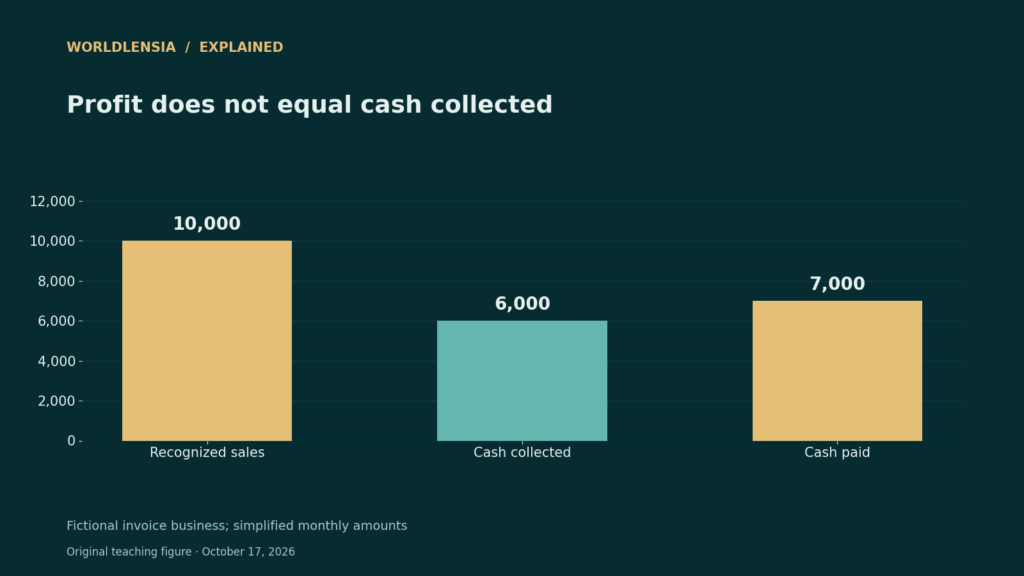
Imagine a service business recognizes $10,000 of sales this month and $7,000 of expenses, giving $3,000 of accounting profit in a deliberately simplified example. Customers pay only $6,000 during the month, while the business pays all $7,000 of those expenses. Its net cash movement from those items is negative $1,000.
The remaining $4,000 of customer invoices helps explain the difference. This example ignores tax, depreciation, financing, and other adjustments. It demonstrates timing, not a complete cash-flow statement. Calling the $3,000 profit “cash available” would misdescribe the situation.
Questions that improve the analysis
Check whether receivables, inventory, or supplier balances changed materially. Ask whether cash came from normal operations, selling assets, or borrowing. An increase in the bank balance funded by a loan has a different meaning from cash generated by customers.
For a practical review, write three short sentences: what happened to sales, what happened to profit, and what happened to operating cash flow. Then explain the main bridge between them using the company’s disclosures. If the bridge is unclear, keep that uncertainty in the conclusion.
A practical comparison
| Fictional monthly item | Amount |
|---|---|
| Recognized sales | $10,000 |
| Recognized expenses | $7,000 |
| Profit in this simplified example | $3,000 |
| Cash received minus cash paid | −$1,000 |
Before using the result
- Match reporting periods.
- Read the cash-flow statement, not only earnings.
- Distinguish operating cash from financing.
Continue exploring: more business and industry explainers.
Sources and methodology
Reviewed October 17, 2026. WorldLensia explanatory analysis. Worked examples and the accompanying teaching figure are illustrative, not measured findings or product tests. Consult the linked source for definitions and revisions.
To reconcile a business result with contract timing and available cash, see Bookings, Billings and Revenue: Three Dates in One Customer Contract and Cash Runway: Replace One Burn Rate with a Dated Cash Forecast.