
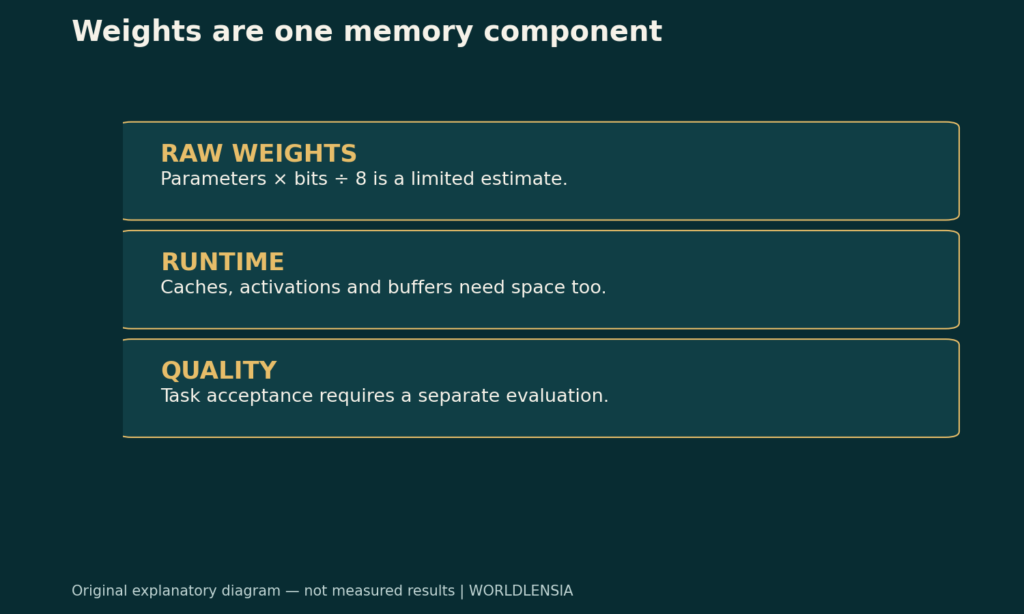
Quantization can make a model’s raw weight storage much smaller, but a model described as “4-bit” may still need far more memory to run than a parameter-count calculation suggests. The multiplication can be useful, but it usually describes raw weight storage under simplified assumptions. An application must also accommodate other data, runtime work and implementation overhead.
The right question is therefore specific: which component becomes smaller, under what representation, and what remains outside the estimate? Answering it helps separate three claims that are often bundled together: that a model fits in memory, that it runs faster, and that it still performs its task acceptably.

Start with one transparent calculation
Imagine a fictional model with exactly one billion stored parameters. If every parameter uses 16 bits, the raw parameter data occupies 16 billion bits. Divide by eight to obtain two billion bytes, or 2.0 GB using decimal units.
At four bits per parameter, the same simplified count becomes four billion bits, or 0.5 GB. That is one quarter of the raw weight storage. It is not a measurement of a downloaded model file or a running application.
| Synthetic representation | Calculation | Raw weight storage |
|---|---|---|
| 16 bits per parameter | 1 billion × 16 ÷ 8 | 2.0 GB |
| 4 bits per parameter | 1 billion × 4 ÷ 8 | 0.5 GB |
The example uses GB, not GiB. It assumes every stored parameter uses the stated bit width and ignores metadata. Those assumptions should remain visible whenever the calculation is reused.
What the weight estimate leaves out
Quantized representations can require scales, grouping information and other metadata. Some parts of a model may remain at a different precision. The actual file can also include configuration information and other stored material. Read the representation rather than assuming that a headline bit width describes every byte.
Running inference introduces additional memory needs. These can include intermediate computations, temporary buffers, application state and, for relevant autoregressive models, a key/value cache. Their sizes depend on the model, implementation and workload. The raw weight formula cannot determine those quantities on its own.
Hugging Face's quantization overview explains that lower-precision storage aims to reduce memory while preserving useful accuracy. It also distinguishes methods and hardware requirements. That documentation supports the need to inspect the method; it is not evidence that a particular configuration achieves a universal speed or quality improvement.
A memory fit is not a speed measurement
Suppose two fictional configurations both fit within a device's available memory. One uses fewer stored bits, but its operations require a different execution path. Without measuring the workload, the smaller representation alone does not establish which finishes first.
Keep loading time separate from steady-state inference. A system used once for a short task may care about loading overhead. A continuously running service may care more about throughput, tail latency or the size of the workload it can hold simultaneously. Those are distinct measurements.
Do not substitute a parameter-count estimate for an observed performance report. If a source claims a speedup, inspect its hardware, software versions, input lengths, output requirements, concurrency and comparison baseline. A result obtained under one set of conditions should not silently become a promise for another.
For a fuller breakdown of timing, see AI response time across the workflow. Reducing one component is useful only when the resulting system still completes the job.

Quality needs its own acceptance test
Compression changes a representation; acceptable quality is an empirical outcome. Choose the task and the failure conditions before comparing configurations. For a classifier, that may include missed positive cases and unnecessary flags. For a document assistant, it may include unsupported statements, omissions and source fidelity.
Use a fixed evaluation set and keep the rest of the comparison as consistent as the experiment allows. Record any necessary changes in prompts, software or execution settings. Otherwise, an apparent precision effect may actually reflect a different task or a changed pipeline.
Inspect important cases rather than relying only on an overall average. A small aggregate change can conceal an important failure on a rare document format or language. Conversely, a minor score difference may be irrelevant to the intended decision. The acceptance criteria should identify which differences matter.
Build a comparison record before running it
A useful record includes the exact base model, quantization method, configuration, package versions and device. It states whether the model was already quantized or converted locally. It identifies which tensors or components use each representation where that information is available.
Add the workload: input lengths, output limits, batch size, number of concurrent requests and any cache policy. For memory, distinguish the measured quantity from a theoretical estimate. For timing, name the stage being timed. For quality, link the evaluation questions and scoring procedure.
If a field is unknown, mark it unknown. Filling the gaps with assumptions produces a more complete-looking table but a weaker comparison. Readers should be able to reproduce the tested configuration or see exactly what prevents reproduction.
Interpret the result within its boundary
Imagine an experiment finds that a particular lower-precision configuration fits a longer workload on the same device. That finding supports the tested memory claim. It does not automatically establish that every output is as accurate, that energy use is lower, or that another device will show the same behavior.
Likewise, a quality test that passes on a bounded collection does not establish all-purpose equivalence. Record the collection and its limits. The AI benchmark and task-success guide explains why a comparison should start from the intended job rather than the most convenient score.
The practical conclusion is to keep the evidence separated. Calculate raw weight storage when it answers the storage question. Measure runtime memory when it answers the deployment question. Test completion time and task quality when they answer the user-experience question. A useful report can combine these results without pretending that one number proves the others.
Storage estimates should name excluded work
If a report uses the 0.5 GB teaching figure, attach the words “raw weights only” directly to it. A reader should not need to find a distant caveat to discover that the application may need additional memory. The same rule applies to file downloads, device memory and memory measured during execution: label which quantity is being reported.
A small comparison note can list the unknown components without inventing values for them. That is more useful than adding an arbitrary safety multiplier and presenting the result as a measured requirement.
Sources and methodology
Quantization concepts were checked against the Hugging Face Transformers quantization overview on October 19, 2026. Its publication/update date was not established; it is rolling software documentation. All parameter counts, memory arithmetic, scenarios and comparison recommendations above are original explanatory work. No model conversion, hardware benchmark or hands-on performance test was performed for this article.
To connect memory estimates with latency and reproducibility, see AI Response Time: Measure the Workflow Before Optimizing the Model and Reproducing an AI Result: Record More Than the Random Seed.