
An AI benchmark can rank a tool highly even when it fails a real workflow. The benchmark may ask different questions, use different inputs, or reward a different kind of answer. A fair evaluation starts with the work you need completed and the mistakes you cannot afford.
At a glance
- A benchmark score describes performance on a particular test.
- Use the same inputs and grading rules when comparing systems.
- Track unsupported answers, failed tasks, time, and review effort separately.
1. Define success before choosing an AI benchmark
NIST’s evaluation work emphasizes repeatable scenarios and measurement. For a practical trial, define what a successful result looks like before inspecting model outputs. “Helpful” is too broad; “extracts the renewal date and cites the correct paragraph” can be checked.
Create examples that reflect ordinary work, awkward edge cases, and missing information. Keep some cases outside the examples used to improve prompts. Otherwise, repeated adjustments can teach your workflow to pass a familiar test without showing that it generalizes.
2. Compare AI benchmark error types
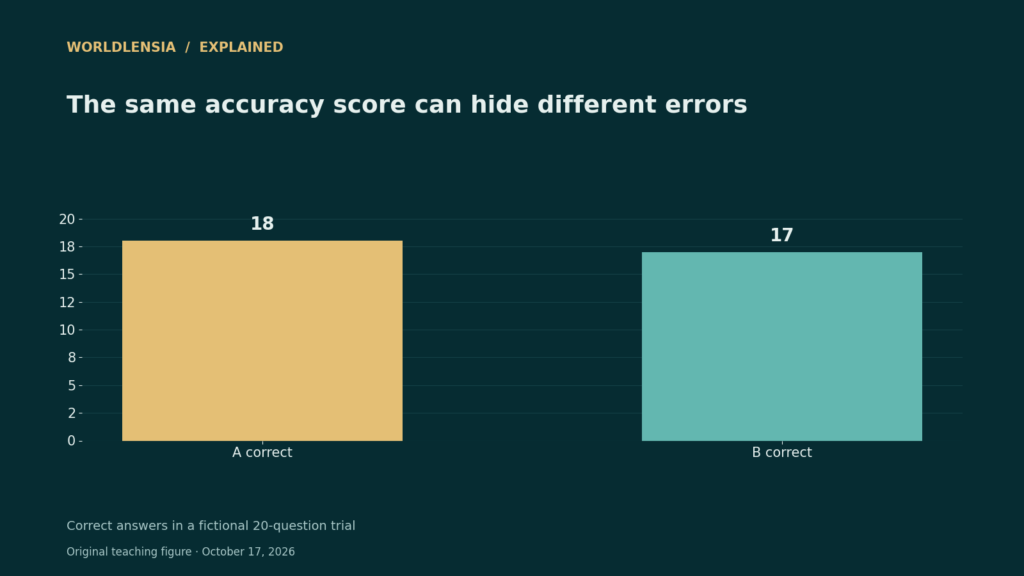
Suppose two fictional assistants answer 20 document questions. System A produces 18 correct answers, one unsupported answer, and one refusal. System B produces 17 correct answers, no unsupported answers, and three refusals. Their correctness rates are 90% and 85%, but that difference does not identify a universal winner.
If an unsupported answer creates a costly customer promise, System B may be preferable after accounting for review. If every refusal needs expensive manual research, the trade-off changes. Label these as hypothetical results and make the cost assumptions visible rather than hiding them inside a composite score.
3. Include human review in the AI benchmark
Measure how much time a reviewer spends checking each answer. A fast response containing plausible but incorrect citations may cost more overall than a slower answer with clear evidence. Record latency and total task time as different metrics.
Run the same cases again when the model, prompt, retrieval library, or tool permissions change. Keep version information with the results. A previous pass is evidence about that earlier configuration, not a permanent certificate for the entire product.
4. Read the AI benchmark comparison table
| Illustrative outcome | System A | System B |
|---|---|---|
| Correct answers / 20 | 18 | 17 |
| Unsupported answers | 1 | 0 |
| Refusals | 1 | 3 |
5. Check the AI benchmark before using the result
- Define success before testing.
- Keep a held-out set of cases.
- Report error types and sample size alongside the headline score.
Continue exploring: our seven-step source-verification workflow.
Keep a reviewable trial record
Use one row per test case. Record the input, expected answer, evidence needed, actual answer, error category, and reviewer decision. For the renewal-date task, a correct date with a citation to an unrelated paragraph should not receive the same assessment as a date supported by the contract. Decide that rule before comparing the systems.
Also record which cases need human escalation and why. A refusal on an unanswerable question can be the appropriate outcome, while a refusal on a straightforward extraction is a different problem. Keep those cases separate. When sharing an AI benchmark summary, include the trial size, configuration, grading rules, and limitations so another reviewer can understand what the result supports.
Sources and methodology
Reviewed October 17, 2026. WorldLensia explanatory analysis. Worked examples and the accompanying teaching figure are illustrative, not measured findings or product tests. Consult the linked source for definitions and revisions.
Preserve the original test cases and reviewer notes so future comparisons can be checked against the same evidence.
To examine error types and the documentation behind a benchmark, see Precision, Recall and Accuracy: Build an AI Evaluation That Matches the Job and How to Read a Model Card Without Treating It as Certification.