
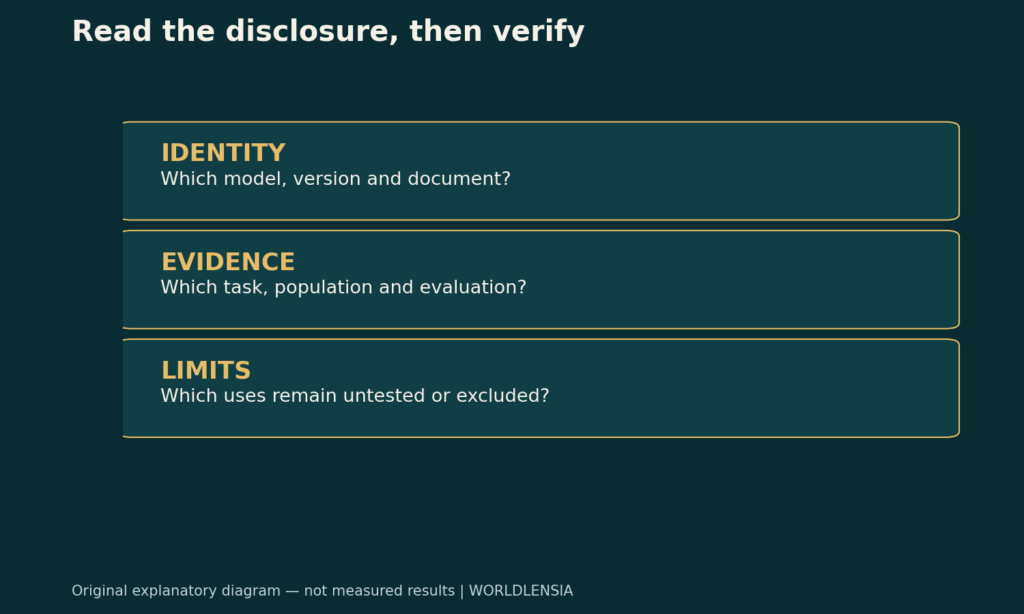
A model card can help explain what a machine-learning model was designed to do, how it was evaluated and where its limitations are. The existence of the document does not establish that the model is appropriate for every proposed use. Read it as a structured set of disclosures and claims that need to be matched to a decision.
The practical task is to identify what the card actually supports. A clearly documented limitation can be more useful than a vague claim of broad capability. An attractive summary or a large benchmark number is not a substitute for the population, task and conditions behind the result.
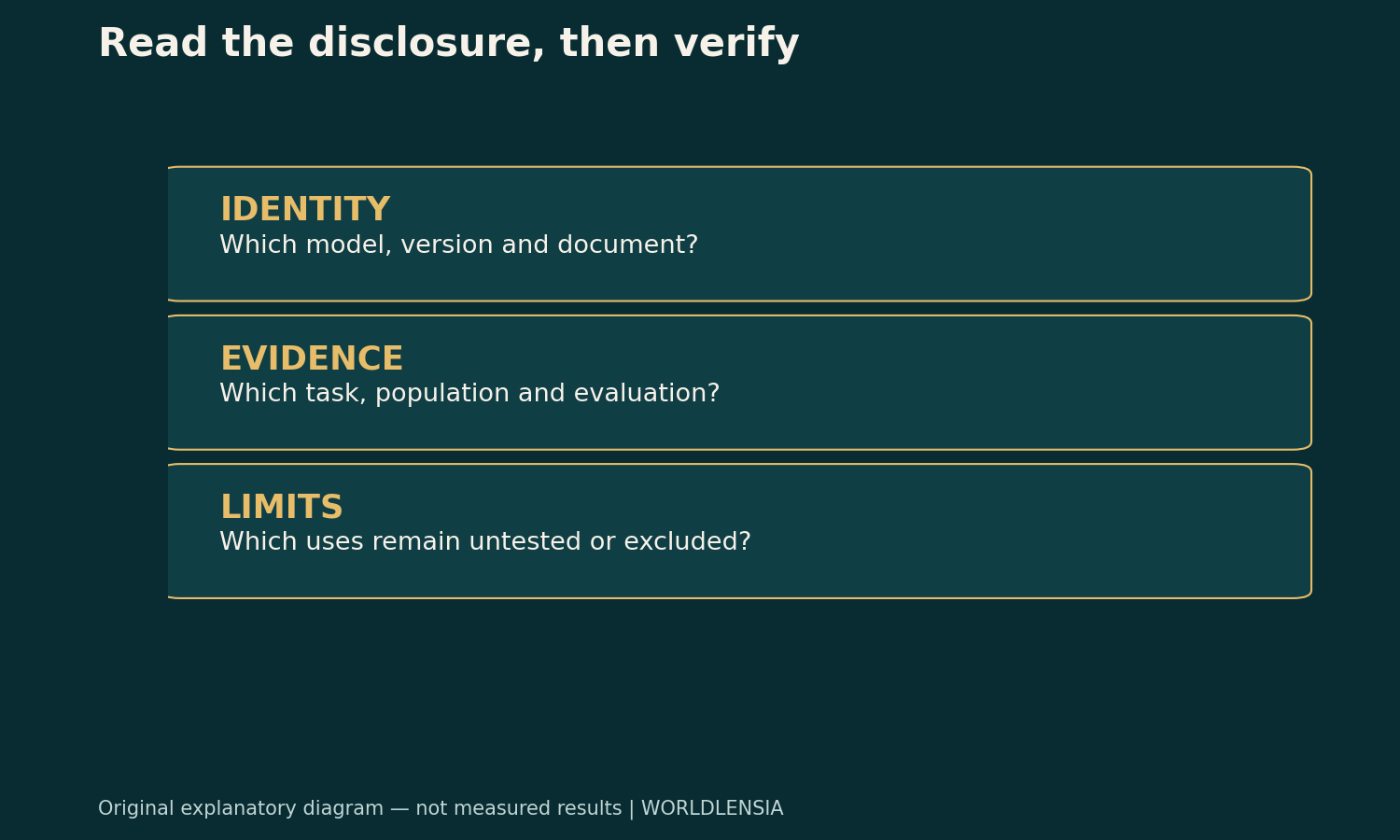
Model card: Start with the model's identity
Record the exact model and version. A card for one checkpoint, update or configuration should not silently become evidence for a different one. Note who produced the card and whether the statements describe the developer's own evaluation, an outside test or a combination.
The original Model Cards for Model Reporting paper proposes documentation that helps communicate intended uses, evaluation and important considerations about a model. That reporting framework is the source for this article's starting point. It should not be mistaken for a certification scheme or a guarantee that every published card follows the same depth of review.
A useful reading record has separate fields for model identity, document version and retrieval date. If the document changes, retain the version you used for the decision. Otherwise, a later reader may be unable to tell which disclosures were available at the time.
Find the intended use before the headline score
Ask what action the model is meant to support. Classifying a document for a human queue, automatically blocking a transaction and answering a general question can require different evidence even when they use related technology.
Look for stated exclusions or limitations. An excluded population or unsupported use is not a minor footnote if it matches the deployment being considered. It is part of the scope of the claim.
If intended use is described only broadly, turn it into a concrete question. What inputs will the system receive? What output will be used? Who will act on it? What happens when the output is wrong or incomplete? These questions help identify which parts of the card are relevant and which additional checks are needed.
A comparison between two fictional cards
Imagine card A says that a fictional document model achieves a high overall score. It does not identify the document types, languages or labeling process behind that score. Card B gives a narrower evaluation: a particular document category, a specified language and a defined review workflow, with a list of untested cases.
Card B's narrower claim is not automatically evidence that its model performs better. It is easier to interpret because the tested scope is visible. Card A's missing detail prevents a fair comparison; it does not prove the undisclosed test was poor.
| Fictional disclosure | What it helps establish | What remains open |
|---|---|---|
| Overall score without task detail | A result was reported | Which job and population it describes |
| Versioned task and dataset description | The evaluation boundary | Whether deployment matches that boundary |
| Listed untested cases | Known evidence limits | Performance on those cases |
| Documented reviewer role | The tested workflow | Whether the real workflow provides equivalent review |
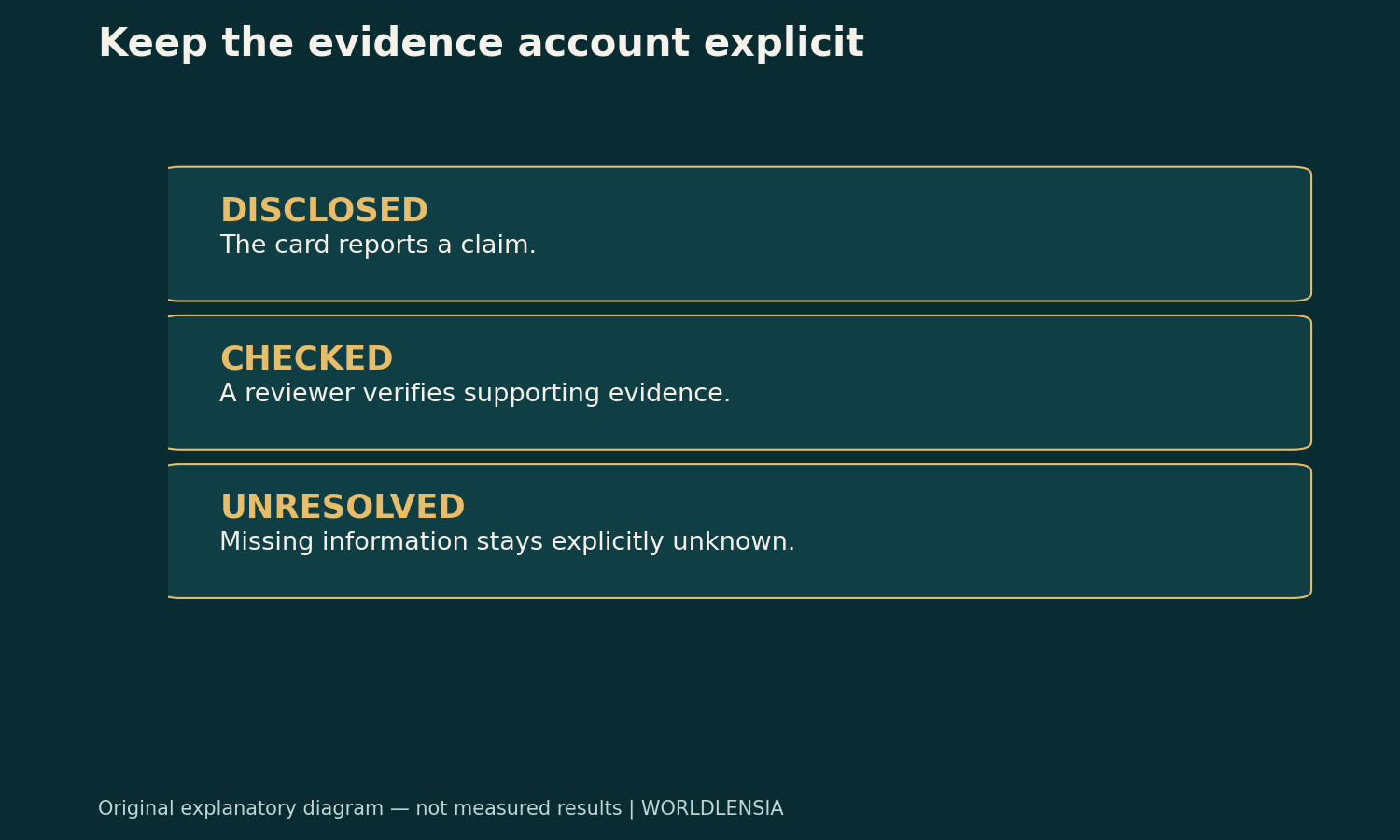
Do not assign a made-up “trust score” to the cards. The useful output is an evidence inventory that distinguishes disclosed information, independently checked information and unresolved questions.
Read the metric together with its denominator
A score needs a task, sample and interpretation. Accuracy on a collection with a rare target class can look strong while missing the cases that matter. A language-generation score may also leave out source support, usability or the cost of correcting the answer.
The AI benchmark and task-success guide explains why the intended job should shape the test. For classification workflows, the precision-and-recall guide shows how different errors appear in the evaluation account.
When reading a card, note whether the metric is reported by relevant subgroup or input type. An overall average can hide different outcomes across those slices. At the same time, small subgroup samples can be uncertain. Do not treat every displayed difference as a reliable ranking without the necessary evidence.
Separate a disclosure from verification
The sentence “the developer reports that the model was evaluated on X” is different from “an independent reviewer reproduced the result on X.” Preserve that distinction in your notes and any public description.
If the card links a dataset or evaluation script, check that it corresponds to the stated result and version. If access is restricted, record the restriction. Do not invent a reproduction claim because the document looks detailed or because a file with a plausible name exists.
Verification also has a boundary. Re-running a script can confirm that a result is reproducible under the checked conditions. It does not automatically confirm that the labels are correct, the sample is representative or the intended deployment is appropriate. Each is a separate claim.
Missing information is a question, not a verdict
A missing field should be recorded as missing. It may make a proposed use difficult to justify, but it does not establish the opposite factual claim. If no subgroup evaluation is supplied, do not say the model failed that subgroup; say the available documentation did not establish performance there.
Turn material gaps into requests or local tests. A deployment involving scanned tables may need evidence on scanned tables. A card focused on clean digital text does not answer that question merely because both inputs are called documents.
This approach avoids two errors: assuming success where no evidence is supplied and alleging failure without evidence. Both can be prevented by a disciplined statement of what the document does and does not show.
Match the card to the complete system
A model is often only one component of an application. Retrieval, input formatting, prompts, post-processing, user interfaces and review rules can affect the result. A card describing the underlying model may not evaluate that combined system.
List the differences between the documented configuration and the proposed workflow. If the application retrieves passages, ask whether source completeness and citation behavior were tested. If humans approve outputs, ask what evidence they see and whether they can intervene meaningfully.
Do not claim that the card is irrelevant because the system has extra components. Use it for the claims it supports, then identify the additional evidence needed for the combined workflow. The goal is to connect evidence, not discard it or stretch it beyond its scope.
Build a decision worksheet
A practical worksheet can contain the proposed use, exact model version, relevant disclosed evaluations, important limitations and unresolved questions. For every consequential claim, record the location in the card and any supporting artifact.
Use statuses such as “disclosed,” “checked,” “not checked” and “not supplied.” Avoid a single color or score that hides why an item passed or failed. The AI citation-audit ledger provides a related way to connect a statement to its supporting passage.
Add an acceptance criterion before testing. If the decision requires a particular failure rate or a reliable escalation path, state how it will be evaluated. Do not define success after seeing the most favorable result.
Revisit the record when conditions change
A new model version, document collection or workflow can change the relevance of the earlier evidence. Preserve the old record and identify which checks need repeating. A dated decision note makes this manageable without pretending every update requires starting from nothing.
For example, a model card may remain useful for the architecture and intended-use discussion while a new language or input format needs separate evaluation. Mark that change explicitly. A broad claim that “the model was reviewed” is less useful than a record of which configuration and use were reviewed.
A precise conclusion
The strongest reading of a model card is conditional. It identifies the model, the tested scope, the reported results and the limits of verification. It then explains how those facts relate to the proposed use.
Treat the document as an organized doorway into the evidence. Its presence is helpful, but its name is not a verdict. The decision should follow the substance of the disclosures and the checks that the intended workflow actually needs.
Avoid interpreting document length as evidence quality
A long model card can still leave the decisive question unanswered. A short card can clearly disclose a narrow test and its limits. Count neither pages nor headings as a substitute for examining the evidence relevant to the intended use.
For each consequential decision, identify the minimum information needed to assess it. A deployment involving a new language needs language-specific evidence; a generic architectural description does not fill that gap. A deployment with human approval needs a description of the combined workflow, not merely a model-only score.
This approach makes the review efficient. Read broadly enough to understand the model, then focus the decision note on the claims and omissions that change the actual choice.
Keep documentation updates separate from model updates
A revised card can clarify an existing model without changing its weights. A new model can also appear with largely reused documentation. Record both identifiers so the review does not confuse a better explanation with a different system.
When a material limitation is added, revisit conclusions that depended on the earlier scope. When wording changes only for clarity, preserve the version history without inventing a performance change. The artifact record should make that distinction visible.
Sources and methodology
The reporting-framework concept was checked against Mitchell and colleagues' Model Cards for Model Reporting, first submitted October 5, 2018, with a revised version dated January 14, 2019. The source was checked October 19, 2026. The fictional cards, comparison table and decision worksheet are WorldLensia's original explanatory analysis. No model certification, independent audit or hands-on evaluation is claimed.
To connect model disclosures with evaluation and reproducibility records, see AI Benchmark Accuracy vs Task Success: Build a Fair Test and Reproducing an AI Result: Record More Than the Random Seed.