
Imputation replaces a missing value with an estimate or a documented substitute. It makes a dataset usable for methods that require complete inputs, but it does not turn an unobserved value into a measurement.
The central question is why the value is missing and whether the replacement preserves information relevant to the task. A convenient default can introduce a pattern the original data never contained. That pattern may affect predictions, explanations and comparisons between groups.
Begin with the collection process
A blank field can mean a sensor failed, a respondent skipped a question, a value was outside the reporting range or a field did not apply. Those cases should not automatically share one replacement rule.
The scikit-learn imputation guide documents different ways to handle missing values, including simple replacements and approaches using other features. [1] NIST’s time-series imputation research addresses filling gaps in sequential data. [2] The existence of multiple methods reflects different assumptions; it does not establish that a complex method is always preferable.
Imagine a fictional dataset used to predict equipment maintenance needs. Some temperature readings are missing because a sensor disconnects. Others are absent because the machine is switched off. If both conditions are coded identically, the model may lose useful information about the operating state.
Why replacing everything with zero can mislead
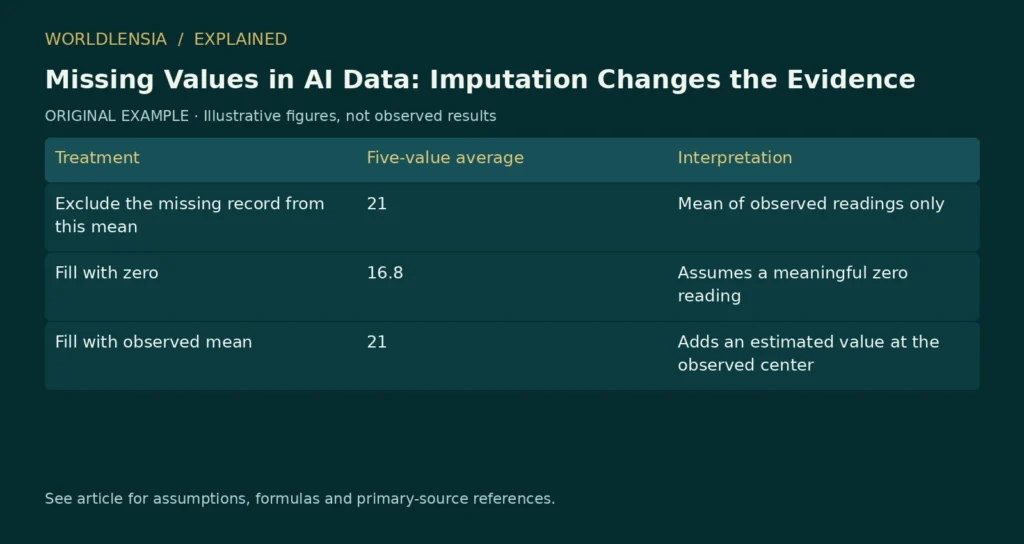
Suppose four observed readings are 18, 20, 22 and 24 degrees, and one reading is missing. The mean of the four observed values is 21. Replacing the missing value with zero makes the five-value average 16.8. Replacing it with the observed mean leaves that average at 21.
These are illustrative calculations. Neither replacement tells us the unobserved temperature. The point is that zero changes the dataset in a specific direction; it is not a neutral way to remove a blank.
| Treatment | Five-value average | Interpretation |
|---|---|---|
| Exclude the missing record from this mean | 21 | Mean of observed readings only |
| Fill with zero | 16.8 | Assumes a meaningful zero reading |
| Fill with observed mean | 21 | Adds an estimated value at the observed center |
Mean replacement also has costs. It introduces repeated central values and can alter variation and relationships with other features. A dataset that looks complete after filling is not equivalent to one in which every value was observed.
Keep an indicator when missingness matters
A separate field saying that the original value was missing can preserve information about the collection process. That can be helpful when missingness has a relationship with the outcome. It can also encode an unstable shortcut.
Suppose a maintenance team historically records detailed readings only after a problem is suspected. A missingness flag might predict the outcome because it reflects staff behavior. If a new monitoring system later collects readings automatically for every machine, that relationship can disappear.
Document how a flag is generated and why it is appropriate for deployment. Do not assume a predictive pattern is a physical explanation. A model can use a collection habit without identifying the underlying mechanism of failure.
Fit replacements using the right data
Replacement values learned from a dataset are part of the model pipeline. Fit them on training data and apply the fitted transformation to evaluation data. Computing a mean across the entire dataset before splitting can allow evaluation information into the training process.
Our guide to test-set leakage explains the broader problem. The same discipline applies to imputation parameters, scaling choices and feature selection. A final test should represent the information available when a real prediction is made.
For time series, also consider order. A method that uses a future reading to fill a past gap may be acceptable for a retrospective reconstruction and unsuitable for a real-time prediction. State which task is being evaluated instead of treating them as interchangeable.
Test the missing-data scenario directly
Report how often each important feature is missing and whether rates differ across time, source or relevant groups. A single overall rate can conceal a deployment segment where the pipeline relies heavily on replacements.
Compare plausible methods on the actual task, including a simple baseline. Examine performance on complete records and records with missing values. If the original missing values are unknown, do not claim to have measured reconstruction accuracy merely because a downstream classifier performs well.
Artificially hiding known values can help test a reconstruction method, but the hiding mechanism should resemble the real collection problem. Randomly removing readings will not fully test a process whose failures occur during extreme temperatures. Label this as a simulation and state its limits.
Preserve provenance in the final dataset
Keep enough metadata to distinguish original measurements, replacements and later corrections. Store the method, training period and version. If an actual value becomes available later, decide how it replaces the estimate and how that change affects downstream reports.
A sensible operational rule may also allow the model to decline a prediction when too much critical information is missing. Completing every row is not always the most useful objective.
Imputation is an explicit modeling choice. Treating it that way helps readers understand which parts of an AI result come from observations, which come from assumptions and which still need investigation.
Write a missing-data rule for one important field
A useful field-level record names the measurement, valid range, possible missing states, replacement method and conditions that require review. For the fictional temperature sensor, distinguish “machine off” from “sensor disconnected” before calculating a replacement. If that distinction cannot be recovered, preserve the ambiguity rather than inventing a cause.
Then describe the deployment test: how often the field was missing, how many affected cases were evaluated and which outcomes were available. A system tested only on complete rows has not demonstrated how its missing-data path performs.
Finally, identify what happens when every reading in a relevant window is missing. A method that needs nearby observations may no longer have the evidence it assumes. The fallback could be a documented baseline, a review route or no prediction, depending on the task. It should be tested as its own case rather than discovered after deployment.
Sources and method
- scikit-learn imputation guide. Living documentation; publication date not established. Checked October 20, 2026.
- NIST Time-series Imputation Algorithm. November 5, 2021. Checked October 20, 2026.
Numerical teaching examples are original and illustrative unless explicitly identified otherwise. No hands-on product testing or individual medical assessment is claimed.
To preserve missingness and avoid leaking test information into preprocessing, see Missing, Suppressed and Zero: Three Different Public-Data States.