
A strong test score can describe an unfair experiment. If information from the test cases influenced model development, the evaluation may no longer represent performance on genuinely unseen cases. The problem can enter before the final model is trained, through preprocessing, feature selection, repeated records or decisions made after inspecting results.
The central question is temporal and procedural: what information would be available when the prediction must be made, and which information was allowed to shape the system? A clean-looking train/test label does not answer that question by itself.
Define prediction time before splitting rows
Start with the action the model supports. If a system predicts whether an order will be returned at the moment of purchase, information created after the return cannot be a legitimate input to that prediction. A later refund status might be highly predictive because it reveals the answer.
The same principle applies to less obvious fields. A processing timestamp, a manually assigned label or a summary created after review can carry future information. Inspect when each feature becomes available, not only whether its name looks relevant.
Write a prediction-time boundary for every feature group. A field can be valid for one task and invalid for another depending on when the decision occurs. Leakage is not a property of a column name independent of the task.
Separate development questions from final evaluation
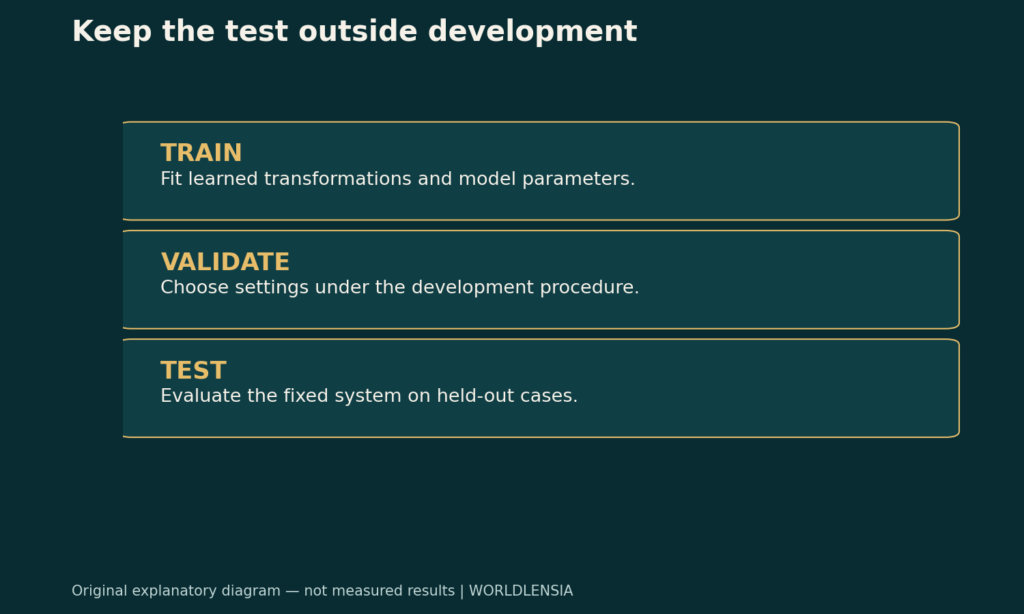
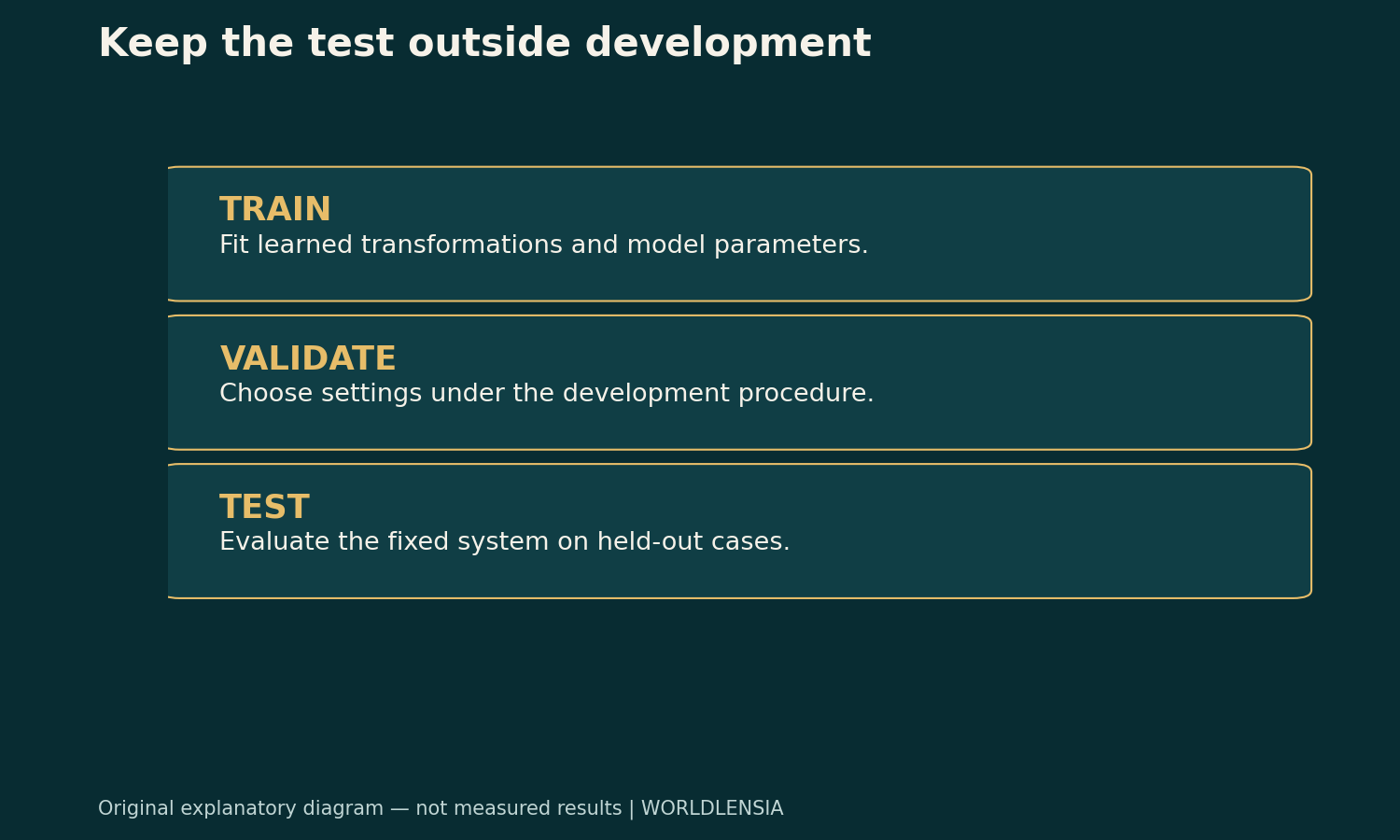
Training data helps fit the model. Validation data can support choices such as configurations or thresholds under a stated procedure. A final test set is reserved for evaluating the selected system rather than continuing to choose it.
Those roles can be implemented in different designs, but their purposes should remain explicit. If a team repeatedly tries changes and selects the one with the best test score, the test set is participating in development even if its rows never appear in the final training call.
Scikit-learn's common-pitfalls documentation defines leakage in terms of information unavailable at prediction time influencing model construction. It specifically warns about fitting preprocessing or feature selection using test data. The examples and audit below extend that principle into an original workflow account.
A fictional household dataset
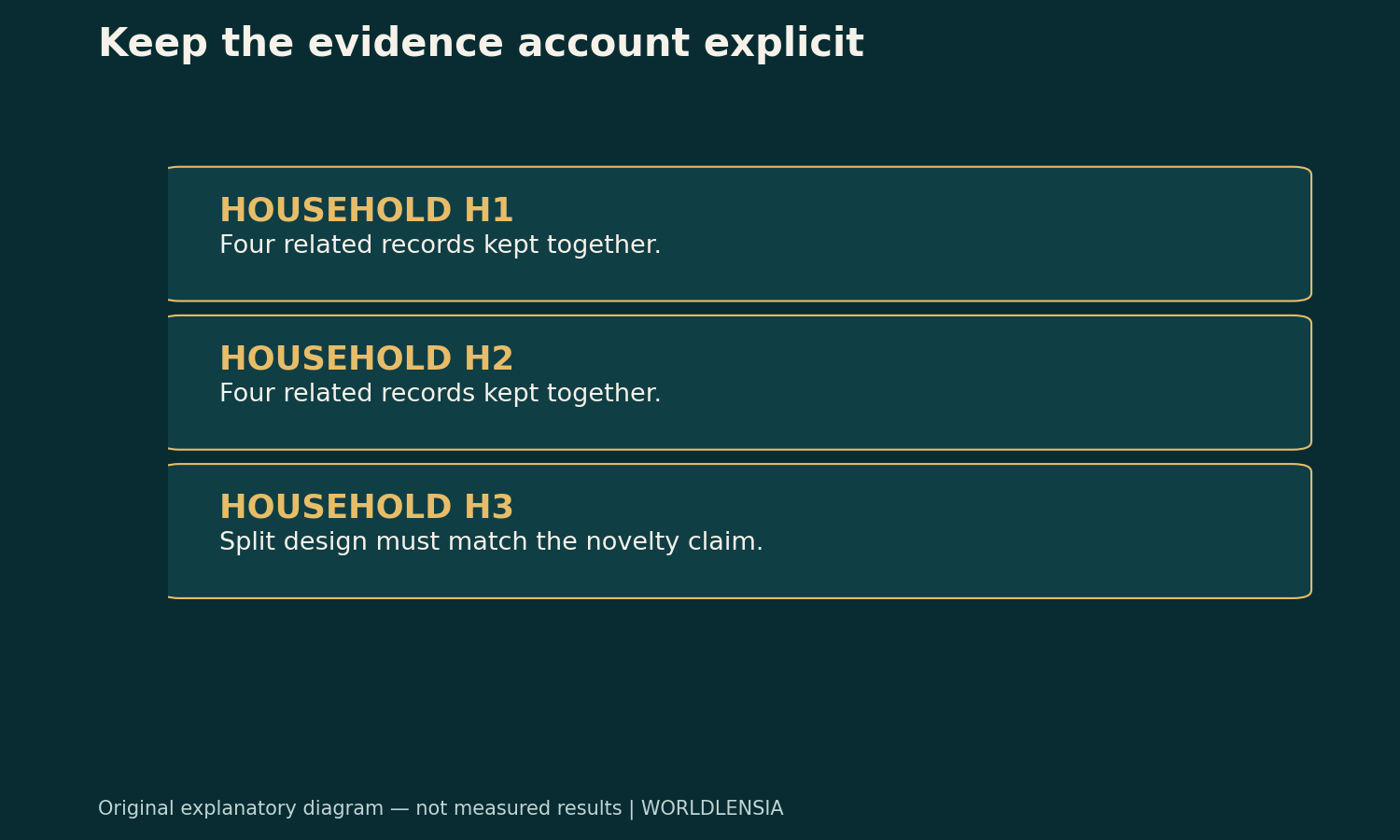
Imagine twelve customer records belonging to three households, with four records per household. Each record has a household identifier, an input created before the prediction and a later outcome label. The dataset is fictional and no model is trained for this article.
If the intended deployment concerns new households, a random row split could put records from the same household into both training and test sets. The model may benefit from household-specific information that would not exist for a genuinely new household.
| Fictional household | Records | Row-split risk | Grouped evaluation idea |
|---|---|---|---|
| H1 | 4 | Related records can cross sets | Keep together |
| H2 | 4 | Related records can cross sets | Keep together |
| H3 | 4 | Related records can cross sets | Keep together |
Grouping is not automatically the correct choice for every deployment. If the system legitimately predicts new events for already known households, the evaluation question differs. Choose the split to match the claim, and state which kind of novelty the test represents.
Repeated records can make novelty look larger than it is
Exact duplicates are an obvious risk, but near duplicates can matter too. A document collection may contain revised copies, templates with small changes or pages from the same source packet. A row-level split can make the test set appear independent while preserving much of its content in development data.
Audit the units that share information: customer, household, document, event, device or source organization. The relevant grouping depends on the task. Do not assume that a unique row identifier establishes an independent case.
If duplicates are removed, document the rule and preserve a record of which cases were affected. Deduplicating only after looking at favorable results can introduce another selection problem. The cleaning process should be part of the declared design.
Preprocessing can cross the boundary
Suppose a preprocessing step learns a mean from all available rows before the train/test split. The test observations have then influenced the transformation applied during model development. The final estimator may fit only training rows, but the complete pipeline has already used test information.
The same concern can apply to feature selection, imputation or dimensionality reduction when their learned quantities are fitted on data that should have remained held out. Distinguish learning a transformation from applying a fixed transformation.
The correct procedure depends on the design, but the boundary should be inspectable: fit learned preprocessing on the permitted development subset, then apply the fitted transformation to the held-out cases. Do not describe the entire dataset as “unseen” merely because one later function received a subset.
A pipeline helps, but it is not a complete guarantee
Software pipelines can organize preprocessing and model fitting so the appropriate transformations are fitted within the intended training process. They reduce opportunities for accidental ordering mistakes and can help preserve boundaries during cross-validation.
A pipeline cannot decide whether the split matches deployment. It also cannot remove a future-outcome feature that the analyst has incorrectly allowed into the inputs. The tool supports a design; it does not supply the task definition or validate every data relationship.
Review the complete path from raw records to reported metric. A correct model-fitting call inside an incorrectly designed workflow can still produce a misleading evaluation.
Time splits need event-level thinking
For a future-prediction task, a chronological split can be more appropriate than random mixing, but dates alone are not enough. Check which date is used and when information becomes available. An event recorded late may refer to an earlier period, while a later correction may reveal an outcome.
Preserve a realistic information cutoff. If the real system would wait for a data feed, the evaluation should not give it a future-complete version of that feed at the earlier decision time. Source revisions can matter as much as row timestamps.
Also inspect overlapping windows. Features summarizing the next seven days are not available at the start of those days. Labels or aggregates built across a split boundary can connect supposedly separate periods.
Threshold selection belongs in development
A classifier's threshold can change its error balance. Selecting the threshold after inspecting final-test outcomes uses those outcomes to shape the policy. The resulting score should not be described as a fresh final assessment of a previously fixed decision rule.
Choose the threshold using the designated development procedure, then evaluate the selected policy on held-out cases. If the test reveals a material weakness and the system is changed, acknowledge that the earlier test has informed development and plan an appropriate new evaluation.
The precision-and-recall guide explains why the threshold matters for the review queue. Keeping its selection separate from final evaluation protects the meaning of that comparison.
Human decisions can leak information too
Leakage is not limited to code. An analyst who sees the expected answers may rewrite prompts, exclude difficult cases or adjust scoring rules in response. A reviewer may also recognize a familiar test case and handle it differently from a new one.
Separate the roles where practical. Preserve a development set for iteration and a final set for the declared check. Record changes to prompts, labels and exclusion rules so a reader can see which evidence influenced the final system.
Do not claim perfect blindness unless the process actually provided it. A transparent account of who saw what is more useful than an unverified statement that the evaluation was independent.
Label leakage and legitimate context differ
Some information is genuinely available and appropriate at prediction time. A customer's prior history may be a valid input for a later event if the task allows it. Removing every predictive contextual field is not a universal solution.
The distinction is whether the information matches the intended deployment and claim. Evaluate a known-customer task as a known-customer task. Evaluate a new-customer task with a design that tests the relevant novelty. Do not report the easier setting as evidence for the harder one without qualification.
This makes leakage review a design exercise rather than a search for forbidden words. The same field can carry legitimate context in one setting and future information in another.
Build a split-and-fit audit
Create a table listing each processing stage, its input data, the quantities it learns and the subsets allowed to influence those quantities. Include data cleaning, vocabulary construction, feature selection, model fitting, prompt iteration, threshold selection and scoring.
For each stage, ask whether the operation learns from the final test or merely applies a previously fixed rule. Record the artifact produced and its version. This lets another reviewer inspect the boundary without reverse-engineering the entire project from a score.
Add grouping and timing fields. A row count alone cannot reveal whether related households, documents or future events crossed sets. An audit should represent the dependencies that matter for the deployment question.
Do not manufacture an improvement figure
It is tempting to illustrate leakage with a dramatic score drop after correction. Unless an experiment was actually run and checked, that number would be invented evidence. This article deliberately supplies no before-and-after model score.
The household table demonstrates a structural risk, not its empirical magnitude. To quantify the effect in a real project, run a documented comparison under compatible conditions and report the actual outcomes, including uncertainty and limitations.
A score that remains strong after a corrected design is useful evidence. A score that falls can also be useful because it reveals the earlier evaluation's scope. Neither result should be predicted or embellished to make the lesson more striking.
A final test is not the same as deployment validation
Even a clean held-out test can be unrepresentative of future use. New document formats, languages, populations or operating conditions can change performance. Leakage control protects one boundary; it does not solve every generalization problem.
Describe how the evaluation set was assembled and which cases it covers. Test important slices and identify where evidence remains thin. Avoid turning a passed test into a universal claim that the system is safe or accurate everywhere.
The AI benchmark and task-success guide provides the broader framing: the evaluation must reflect the job. Split integrity is one necessary part of making that reflection credible.
Preserve the denominator and exclusions
Record how many cases enter the final metric and what happened to invalid, missing or failed outputs. Excluding failures after seeing them can make a clean split look better than the complete workflow actually performs.
Use a predeclared rule for technical failures where possible, and show the counts. If an exclusion is justified after an unexpected issue, explain it and report how it affects the conclusion. Do not silently remove the cases that make the comparison inconvenient.
The evaluation population should remain traceable from raw eligibility to scored cases. That account is as important as the formula used for the final percentage.
Negative controls can test the process
A carefully designed control can help expose a suspicious evaluation path. For example, a project might use an appropriate randomized-label check to investigate whether a pipeline produces implausibly strong results from information that should not predict the outcome.
The control must be designed and interpreted correctly. It is not a universal proof that every remaining source of leakage is absent. State the specific failure the control could reveal and what a result would mean.
Do not report a control result that was not executed. A proposed test belongs in the plan; an observed result belongs in the evidence record with its inputs and method.
Responding to a discovered leak
First identify which reported claims depend on the compromised evaluation. Preserve the earlier record, correct the design and determine what new evidence is needed. A narrow preprocessing issue may affect a specific comparison; a broad test-set reuse problem may affect many conclusions.
Re-run the relevant evaluation under a documented corrected procedure. Explain the change and distinguish the old result from the new one. Do not quietly replace a score while leaving the original interpretation unchanged if the evidence no longer supports it.
If the system is already in use, assess the operational implications separately. A research correction does not automatically establish the impact on every user, but it is a reason to investigate the affected decision process.
A compact acceptance record
The final record should identify the intended task, prediction-time boundary, dataset versions, grouping units, split assignments, learned preprocessing, development choices and final scoring procedure. It should state what was held out and which people or stages had access to it.
Add the result, uncertainty and remaining coverage limits only after the procedure is fixed and executed. A reviewer should be able to understand why the test is a fair assessment of the claimed use without trusting the headline score alone.
The central lesson is that an evaluation is a chain of information decisions. Protecting the final rows is useful, but protecting the meaning of “unseen” requires checking every stage that shaped the system.
Cross-validation does not remove the design question
Cross-validation rotates which observations serve as held-out cases under a specified procedure. It can make better use of limited data for a development comparison, but it does not automatically resolve related records, future information or an inappropriate population boundary.
Apply learned preprocessing within the permitted training portion of each fold. If a feature-selection step sees the full dataset first, rotating the later estimator's folds does not undo that earlier access. The audit needs to follow the entire pipeline rather than only the final fitting stage.
Grouping and time restrictions can also remain necessary. A household appearing in several folds may undermine a claim about entirely new households. A time-mixed fold may undermine a claim about future performance. Choose the resampling design for the question, then describe what it actually tests.
Public benchmark familiarity needs a careful claim
When test questions are public, development teams and models may have encountered related material. That possibility is not evidence that a particular result is contaminated. It is a reason to inspect the benchmark's design, provenance and disclosure practices before making a strong independence claim.
Do not accuse a named system of leakage based only on an unusually high score or a familiar-looking answer. A credible allegation requires evidence connecting the evaluation content to the development process. Preserve uncertainty when that evidence is unavailable.
A project can supplement a public benchmark with an appropriately designed fresh evaluation, but “fresh” also needs a procedure. Record who created the cases, when they were fixed, who could inspect them and whether they were used for iteration before the reported test.
Data access is not the same as permission to use it
A dataset may be available to a project while still being reserved for a particular evaluation role. Treat that role as part of the protocol. A developer's ability to open a file does not mean its labels should shape every decision.
Practical controls can include separate directories, access records or a designated evaluator, depending on the project. Those controls support the boundary but should not be described as proof that no information ever crossed it. Verify the process that actually occurred.
If a small team cannot provide strict role separation, document the limitation and choose a realistic design. Honest scope is better than a claim of independence that the workflow could not support.
The audit should survive a handoff
Another analyst should be able to identify the exact split, the feature-availability rules and the sequence of development decisions without reconstructing them from informal messages. Save a concise README that links the relevant artifacts and states which checks were executed.
Include a change log when the design evolves. If the final evaluation set is replaced after a discovered issue, retain the reason and distinguish the new result from the old one. That history makes the correction assessable rather than suspiciously invisible.
The goal is not paperwork for its own sake. It is to preserve the information needed to decide whether the reported score still means what the headline says it means.
Retain a feature-availability register
For every proposed input, write the earliest time it is available, the system that supplies it and any later revisions. Include derived features as well as raw columns. A summary calculated today from a complete history may contain information that was not available at the historical prediction date.
Check the register against sample records. A field description can be correct in principle while an export contains later backfilled values. If a historical snapshot is unavailable, state the limitation rather than claiming a realistic past-time evaluation.
The register can also distinguish operational availability from experimental availability. A field in a research file may be costly, delayed or unavailable in the deployed workflow. An evaluation that depends on it should disclose that dependency even when it does not reveal the label directly.
These checks make the final claim more useful: the result describes a system that could receive the stated inputs at the stated time, not merely a model that can score a conveniently complete spreadsheet.
Sources and methodology
Leakage and preprocessing principles were checked against scikit-learn's Common Pitfalls and Recommended Practices on October 19, 2026. The retrieved documentation identified version 1.9.1; its publication/update date was not established. Household records, workflow examples, audit questions and proposed controls are original explanatory material. No model was trained, no score change was measured and no named vendor is alleged to have contaminated an evaluation.
To check preprocessing and the evaluation design for leakage, see Missing Values in AI Data: Imputation Changes the Evidence and AI Benchmark Accuracy vs Task Success: Build a Fair Test.