
Lowering a language model's temperature can make its output less varied, but it does not provide a factual reference, update an old document, or establish that a citation exists. A system can repeat the same unsupported answer consistently. Consistency and correctness are separate properties and should be measured separately.
Temperature affects sampling in generation systems that support it. The Hugging Face generation documentation describes it as a parameter that modifies next-token probabilities. Support and behavior vary across models and interfaces, so confirm the actual implementation rather than copying a setting from an unrelated example.
This article uses a small invented probability distribution to explain the mechanism. It does not claim that a particular model uses these probabilities or that any temperature value guarantees a particular business outcome.
A probability example
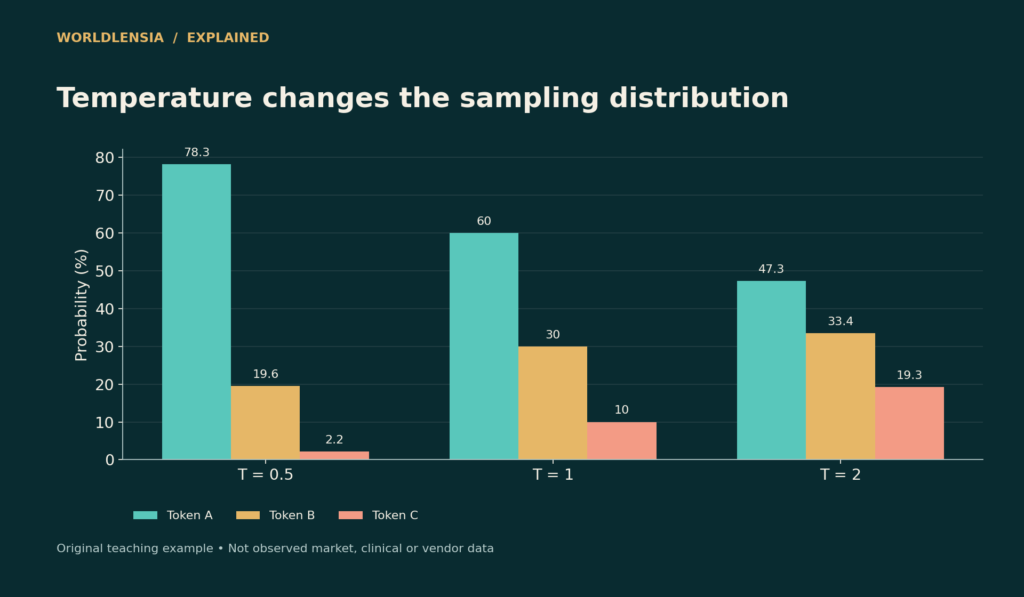
Suppose three possible next tokens have probabilities 0.60, 0.30, and 0.10. In a simplified temperature transformation, each probability is raised to the power of 1/T and then normalized. At T = 1 the probabilities stay the same. At T = 0.5 their unnormalized weights become 0.36, 0.09, and 0.01, producing approximately 78.3%, 19.6%, and 2.2% after normalization.
At T = 2 the distribution becomes flatter: approximately 47.3%, 33.4%, and 19.3%. The leading option is still the leading option, but alternatives receive more probability. This is a mathematical illustration of sampling, not a forecast of answer accuracy.
| Temperature in teaching example | Leading token probability | Meaning |
|---|---|---|
| 0.5 | 78.3% | More concentrated sampling |
| 1.0 | 60.0% | Original distribution |
| 2.0 | 47.3% | More spread across alternatives |
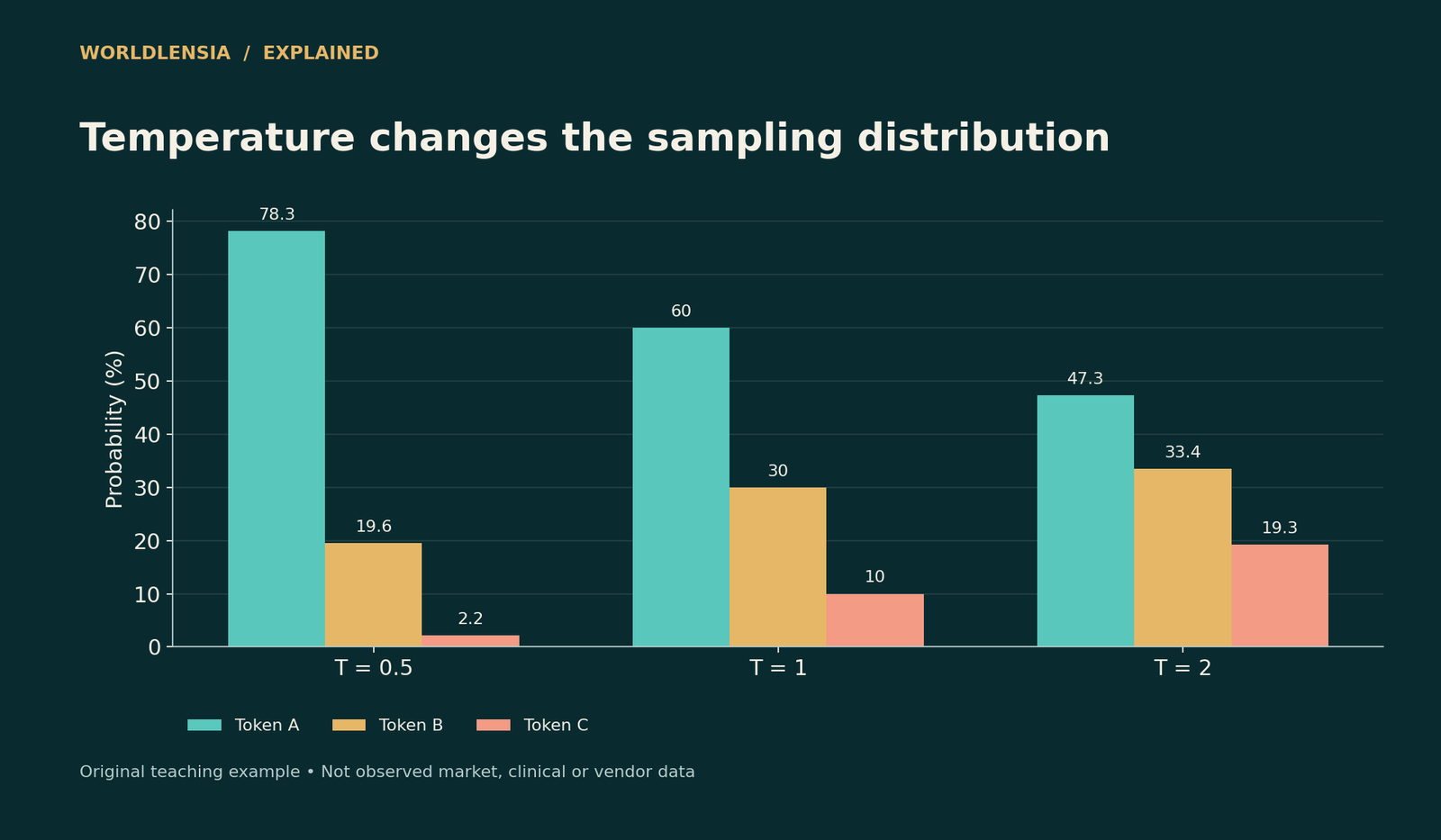
Figure data and assumptions
Original hypothetical teaching data; see the caption and article for assumptions.
| Category | Token A | Token B | Token C |
|---|---|---|---|
| T = 0.5 | 78.26086956521739 | 19.565217391304348 | 2.1739130434782616 |
| T = 1 | 60.00000000000001 | 30.000000000000004 | 10.000000000000002 |
| T = 2 | 47.27338749895048 | 33.42733287016724 | 19.299279630882282 |
The figure compares the complete distributions. The token names are A, B, and C precisely because no real factual proposition is being evaluated. An attractive probability chart should not smuggle in a claim about knowledge.
Why confident repetition can still be wrong
Imagine a question about an organization whose policy changed last week. If the input contains only an older policy, lowering temperature does not add the missing update. The system may simply repeat the obsolete rule more consistently. Retrieval, source selection, and version checks address the missing information.
A similar issue occurs with fabricated citations. A low-variation response may keep generating a plausible-looking reference that has not been checked. Test whether the document exists, whether the linked passage supports the claim, and whether the date is appropriate. Repeated spelling of an invented title is not verification.
Match the experiment to the task
For a constrained extraction task, evaluate whether each required field matches the source and whether missing values remain explicitly missing. For brainstorming, evaluate variety, relevance, and the usefulness of alternatives. A setting that helps one task can hinder another.
Keep prompts, input records, model version, tool access, and output format fixed when comparing settings. Run multiple attempts because one sample cannot describe variability. Record both quality and variation instead of selecting the most impressive output from a large undisclosed collection.
Do not confuse temperature with every other control
Sampling systems may also support top-p or top-k selection, repetition controls, length limits, and other generation options. Their interactions matter. Changing several settings at once makes it difficult to determine which change affected the result. Some interfaces ignore or restrict certain parameters for certain models.
Temperature approaching zero is also not the same mathematical operation as substituting zero into a formula containing 1/T. Implementations may use greedy selection or another defined behavior. Check the service documentation and measure repeated outputs rather than promising perfect determinism.
A practical review record
Create a record for each candidate setting containing the task, source set, configuration, number of runs, factual pass rate, formatting pass rate, and reviewer notes. Include failed or incomplete requests. If a response was discarded because it lacked evidence, it should not disappear from the evaluation.
Separate errors into categories: unavailable information, wrong source, misreading, unsupported inference, format failure, and inappropriate confidence. A temperature adjustment is only one possible intervention. Better instructions, better evidence, structured validation, or a human decision may be more relevant.
Separate format stability from semantic stability
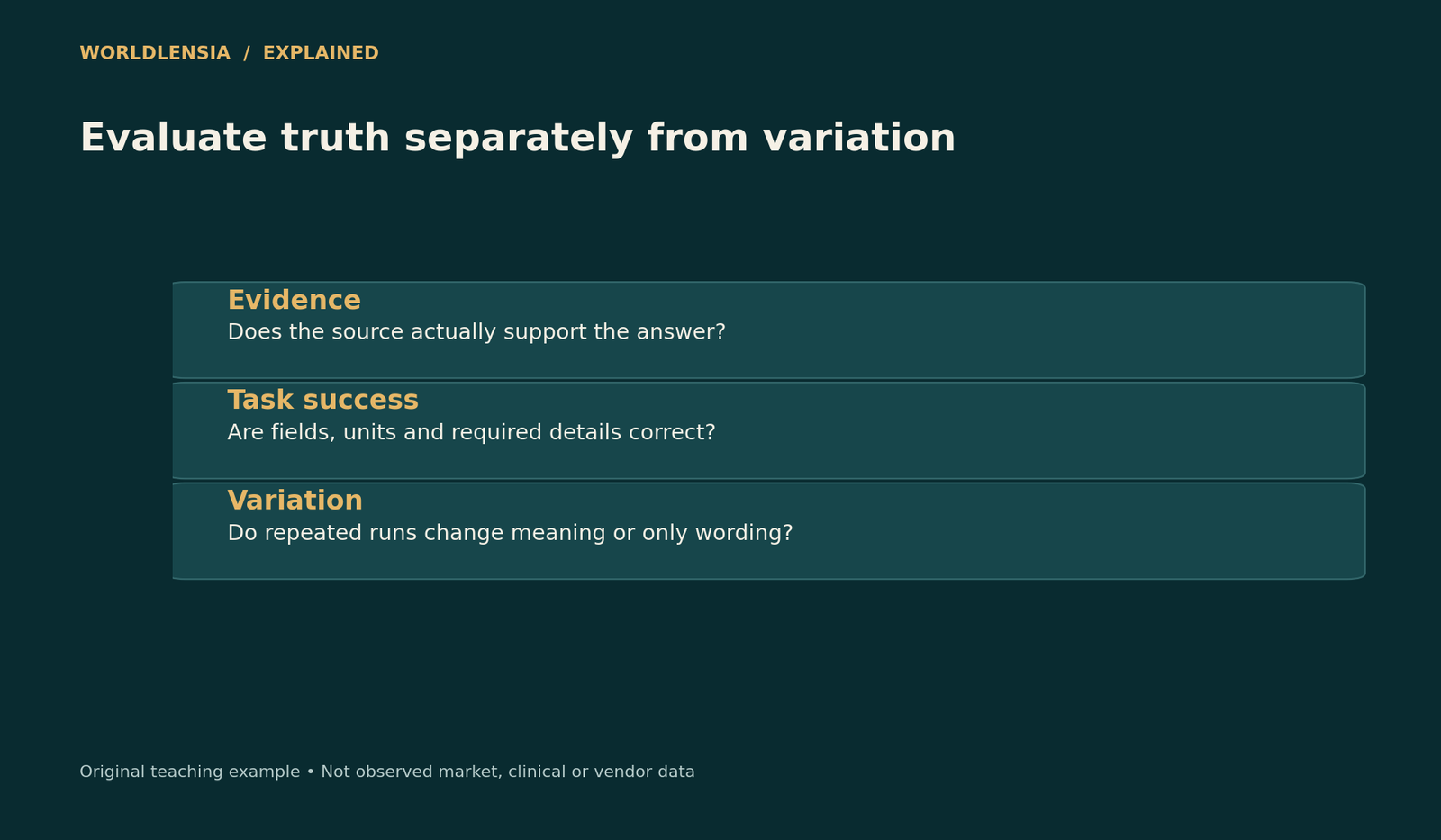
Two responses can use different words while expressing the same correct answer. They can also use nearly identical wording while changing an important number or exception. A string-similarity score therefore does not establish whether repeated outputs are substantively consistent.
For a factual extraction task, compare the fields that matter: identifier, amount, date, unit, and source location. For an explanation, use a rubric addressing the core conclusion and qualifications. Preserve wording variation as a separate observation rather than treating every difference as an error.
Suppose ten repeated runs all return the required schema, but two fill an absent date with an invented value. Format success is 100%, while full task success is lower. Lowering temperature might reduce those inventions, increase them, or leave them unchanged; only the experiment can establish what happened in that configuration.
Save the full configuration
Record model version, sampling controls, system instructions, retrieved evidence, tool results, and validation logic. A change in any of these can affect the output. A comparison described only as “temperature one versus zero” may conceal a simultaneous model or source change.
If an API does not support the requested setting, do not report that it was applied. Capture the actual accepted configuration or documented default. A benchmark report should distinguish an intended parameter value from a verified one.
What to conclude
Use temperature to investigate variation where the model supports it. Use evidence and evaluation to investigate truth. A strong production workflow can combine restrained generation, reliable sources, explicit uncertainty, and review, but it should not represent one sampling value as a substitute for the rest.
For a practical next step, pair this article with WorldLensia's AI citation-audit guide. Verify the source first, then decide whether a more or less varied expression helps the reader. The order matters because style controls cannot repair absent evidence.
Use a negative control
Include a question whose answer is absent from the supplied material. Repeated unsupported answers expose a problem that a stylistic consistency score would miss. The appropriate successful result may be an explicit statement that the evidence is insufficient. Keep this test separate from a question with a known answer, and define the expected behavior before running it. That gives the experiment a chance to disprove the assumption that lower variation means better factual behavior. If all settings fail, investigate evidence and task design rather than selecting the least varied failure.
Sources and methodology
Hugging Face Transformers generation documentation was checked October 18, 2026. The three-token distribution and its transformations are original calculations. The article contains no hands-on benchmark or claim about proprietary internal model probabilities.
- Hugging Face: Generation configuration — checked October 18, 2026.
Continue with AI detector scores and their limits and Check AI source claims for related context.
To separate sampling settings from evidence and reproducibility, see Valid JSON Is Not a Verified Answer: Check AI Structured Outputs and Reproducing an AI Result: Record More Than the Random Seed.