
Business backlog describes future work or revenue under a company’s stated definition. It is not automatically revenue already earned, cash already collected or a guarantee that every listed project will be completed.
The useful question is how backlog converts into delivery, recognized revenue and cash, subject to the contract’s conditions. A growing total can reflect healthy demand, slower execution, a change in definitions or several forces at once.
Read the company's definition first
Backlog is not a universal unit. A company may distinguish funded work, unfunded work, options or other categories. The Booz Allen Hamilton filing cited here discusses conditions that can delay or prevent revenue from backlog, including funding and contract changes. [1] This is an example of a company’s disclosure, not a definition to impose on every industry.
The SEC’s financial statement guide distinguishes income-statement results from cash-flow information. [2] That broader separation matters because future contracted work, recognized revenue and cash receipts can occur at different times.
For each company, record the definition, measurement date, included contract types and treatment of cancellations. Comparing two backlog totals without those details can create false precision.
Reconcile a fictional backlog bridge
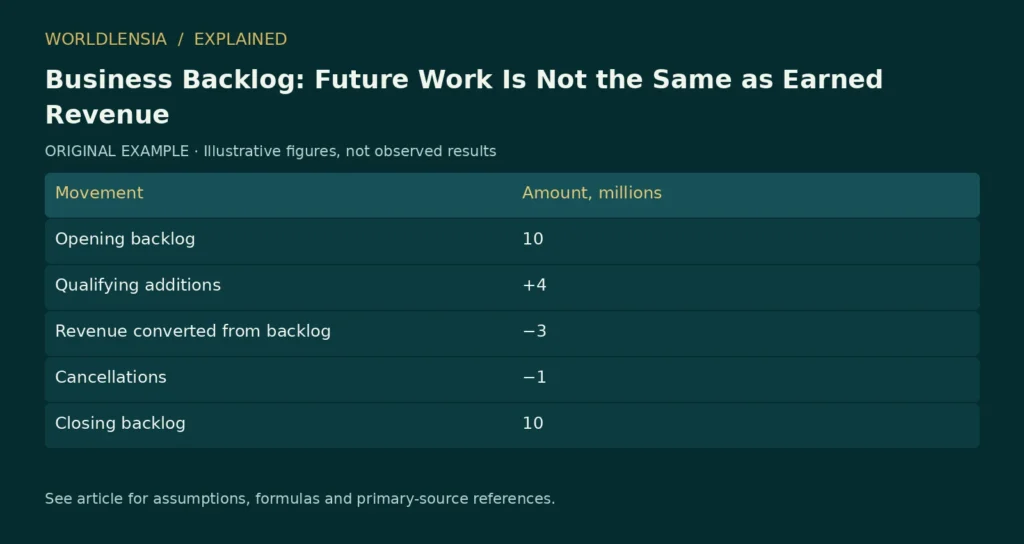
Suppose a simplified business begins a quarter with 10 million currency units of backlog. It adds 4 million in new qualifying orders, recognizes 3 million of revenue from the backlog and removes 1 million through cancellations.
| Movement | Amount, millions |
|---|---|
| Opening backlog | 10 |
| Qualifying additions | +4 |
| Revenue converted from backlog | −3 |
| Cancellations | −1 |
| Closing backlog | 10 |
The closing total is unchanged, but the business has not been inactive. It added work, delivered work and lost work. A single ending balance would conceal these movements.
This is a fictional reconciliation. Actual company definitions may include foreign-exchange effects, acquisitions, scope changes or categories that do not reconcile to total reported revenue in this simple way. Use the disclosed bridge when available.
Growth can reflect slower delivery
Consider a second fictional quarter with the same opening backlog and additions but only 1 million converted into revenue. With no cancellations, ending backlog becomes 13 million.
The larger backlog might look encouraging, but the difference could be a delivery delay rather than stronger incoming demand. Check additions, conversion timing and operating capacity before interpreting the increase.
That does not imply all backlog growth is bad. A firm winning long-duration projects can legitimately build future work. The point is to identify which mechanism increased the total and what obligations come with it.
Assess quality as well as quantity
Read whether the work is funded, whether the customer can cancel, when performance is expected and what assumptions underpin estimated values. A long-term option is different from a near-term committed delivery under the company’s own definition.
Also examine customer concentration and project duration. A large total concentrated in one customer can have different risk characteristics from the same amount spread across many customers. Duration affects how quickly the balance may become revenue.
A backlog figure may be nominal. If input costs rise while fixed contract prices remain unchanged, revenue visibility does not guarantee margin protection. Contract terms and cost assumptions matter to the economics of completing the work.
Do not divide blindly to estimate “years of revenue”
A common shortcut divides backlog by annual revenue. In a fictional case, backlog of 20 million and annual revenue of 10 million produces a ratio of two. That does not prove that the next two years’ revenue is secured.
Some backlog may convert after that interval, some revenue may come from activities excluded from backlog, and some work may be canceled or modified. The ratio can be a descriptive starting point only if its limitations are made explicit.
Use management’s conversion expectations carefully and label them as expectations. They are not completed results. If later reports revise the timing, preserve the earlier statement and identify what changed.
Track cash separately
A customer deposit can produce cash before performance. A completed delivery can produce revenue before collection. Backlog alone cannot tell you which situation applies.
Our explanation of revenue, profit and cash flow helps separate these timelines. A company can have substantial future work and still face near-term cash requirements to buy materials, pay staff or finance receivables.
For a useful review, place backlog beside revenue recognition, operating cash flow, contract assets and liabilities, and the relevant accounting notes. Do not infer the direction of cash from backlog growth alone.
Present an accountable summary
A clear backlog discussion names the company-specific definition and date, explains additions and conversion, and identifies the main conditions affecting realization. Distinguish reported facts from projections about future delivery.
If two companies use incompatible definitions, explain the incompatibility instead of forcing a ranking. Where definitions change over time, seek a comparable restatement or mark a break in the series.
Backlog is most informative when it is treated as a structured view of future work. The balance becomes useful through its terms, timing and conversion evidence, rather than through the assumption that every currency unit will soon arrive as profit or cash.
Build a twelve-month conversion view
A backlog total has a measurement date, while conversion occurs over intervals. A more useful planning view divides expected work into dated periods under explicit assumptions. The aim is to reveal timing rather than manufacture certainty from the total.
Suppose the fictional business has 10 million of opening backlog. Its internal plan expects 2 million to convert in the first quarter, 3 million in the second, 3 million in the third and 2 million in the fourth. The planned total is 10 million, but each period has a different operational load.
Now assume one 2-million project originally expected in the second quarter moves to the fourth. The revised pattern becomes 2, 1, 3 and 4 million. The full-year planned conversion is unchanged, while the middle and end of the year look substantially different.
That shift can affect staffing, purchases and cash needs even if the ending backlog headline does not change. A schedule-sensitive business should therefore examine the path through the year rather than only the annual total.
The numbers are invented and exclude new orders. In an actual plan, separate the conversion of existing backlog from forecast revenue associated with business not yet won. Otherwise the reader cannot see how much of the outlook depends on future selling.
Add a cancellation scenario without disguising it as a forecast
Suppose the fictional 10-million backlog includes 2 million subject to an explicitly modeled cancellation scenario. A scenario in which that work is canceled reduces the remaining potential conversion to 8 million, before any replacement orders.
Do not label the 8-million figure as a probability-weighted expectation unless a probability model and supporting evidence exist. A scenario answers “what if this happens?” An expected value answers a different question and requires justified weights.
A table can show the unchanged baseline, a delayed-delivery case and a cancellation case. Name the changed assumption in each row. Readers can then understand whether a lower result comes from timing, lost work or both.
If the company reports its own probabilities or expected conversion, attribute those statements and dates accurately. A journalist’s illustrative scenario should not be presented as management guidance or an analyst consensus.
Distinguish funding status from payment timing
Funding, billing and collection are related but separate concepts. A contract being funded under a company’s definition does not automatically mean the customer has paid in advance. A payment can also arrive before all associated work is recognized as revenue.
For each material category, ask what event permits work to proceed, what event permits invoicing and what terms govern collection. The answer may vary across contracts, so do not impose a simple sequence without reading the terms.
In a fictional project, a customer pays a 20% deposit on a 1-million contract, and the firm buys materials immediately. The 200,000 receipt is cash, while the remaining contract amount is not yet cash. The deposit also does not establish that 200,000 is immediately earned under every accounting framework.
If upfront purchases exceed the deposit, the project can require financing before later payments arrive. A large order can therefore increase the need for working capital even while it improves visibility of future work.
Compare conversion and margin as separate outcomes
A project can convert from backlog into revenue at a disappointing margin. Suppose a fictional fixed-price project has revenue of 1 million and initially expected relevant costs of 800,000. The simplified expected contribution is 200,000.
If the specified costs rise to 950,000 while the price stays fixed, the contribution falls to 50,000. The revenue conversion is still 1 million under the example’s assumptions. A dashboard that records only conversion would miss the deterioration in the project’s economics.
These figures are a simplified contribution example, not a complete income statement. They omit overhead, tax and accounting complications. Their purpose is to show that revenue visibility and profitability are different claims.
An operating review can therefore track conversion, delivery milestones, cost-to-complete assumptions and collection. Each needs its own definition. A single green backlog indicator cannot stand in for all four.
Account for scope changes explicitly
A contract can be expanded, reduced or reorganized. A backlog bridge should distinguish new work from changes to work already included. Otherwise repeated amendments can be mistaken for a series of separate customer wins.
Consider an opening project value of 1 million with 400,000 already recognized under the example’s definition. Remaining work is 600,000. If the remaining scope is reduced by 100,000, the balance falls to 500,000 without that reduction representing delivered work.
Conversely, an approved 200,000 expansion increases the remaining amount under the assumed policy. Whether and when it qualifies for the reported backlog depends on the company’s definition. Preserve the approval and measurement dates in the analysis.
The important distinction is between a movement caused by performance and one caused by a revised obligation. Both change the balance, but they have different meanings for demand and execution.
Make a comparability worksheet for two businesses
Before comparing totals, record each company’s fiscal period, currency, contract scope, funding categories, treatment of options, cancellation provisions and acquisition effects. Include the source location and any definition change.
Then ask whether a common comparison is possible. If one firm includes optional extensions and another excludes them, a raw ratio of backlog to revenue may not be comparable. A discussion can still describe both policies without forcing a numerical winner.
Currency conversion requires care as well. Converting two totals into one currency does not align their definitions or their measurement dates. It only changes the unit of account under the stated conversion method.
A company with a longer project cycle can naturally carry more backlog relative to current revenue. Interpret the ratio in the business model rather than assuming a larger number means superior demand or lower risk.
Design a reader-facing evidence table
A strong table can contain opening backlog, additions, conversion, cancellations, other adjustments and closing backlog. Add separate columns for observed figures, company expectations and editorial scenarios when all three are discussed.
Do not mix those statuses in the same unlabeled series. A solid line for history and a distinct treatment for a forecast can help, but the text and legend must explain the distinction for readers who cannot see color differences.
Keep units and dates in the headers. If a figure is rounded, allow a small reconciliation difference and explain it. If an unexplained gap is large, investigate the source rather than inventing an adjustment row.
Use the balance to ask a better next question
If backlog rises, ask whether additions accelerated or conversion slowed. If it falls, ask whether work was delivered, canceled or reclassified. If revenue rises, ask how much came from the opening balance and how much from newly received work.
Those questions turn the backlog figure into an operating narrative with evidence. They also identify what remains unknown when disclosures are limited.
A responsible article can conclude that future work increased under the company’s definition while leaving conversion and profitability uncertain. That is a useful result. It preserves the information actually reported without upgrading a conditional pipeline into guaranteed revenue, cash or earnings.
A final worked disclosure check
Suppose a fictional report says opening backlog was 10 million, additions were 4 million and closing backlog was 11 million. It would be tempting to infer that exactly 3 million converted to revenue. That inference is valid only if conversion is the sole omitted movement and the definitions align.
If the period also includes cancellations, currency changes or acquired backlog, the missing amount combines several effects. Ask for the bridge or describe the unknown reconciliation. Do not insert the residual into a revenue row merely because it makes the table balance.
The same check applies when reading a chart prepared by the business. A reconciliation difference can identify a useful question without proving misconduct or an accounting error. Preserve the disclosed values, identify the missing definitions and limit the conclusion to what the evidence supports.
For an article, a small note saying “conversion cannot be isolated from the disclosed totals” is more useful than a precise invented estimate. It tells readers which additional disclosure would resolve the gap.
Sources and method
- Booz Allen Hamilton fiscal 2026 filing, backlog disclosures. Fiscal year ended March 31, 2026. Checked October 20, 2026.
- SEC financial statement guide. Published February 4, 2007; reviewed February 5, 2007. Checked October 20, 2026.
Numerical teaching examples are original and illustrative unless explicitly identified otherwise. No hands-on product testing or individual medical assessment is claimed.
To distinguish future work from contract timing and cash, see Bookings, Billings and Revenue: Three Dates in One Customer Contract.