
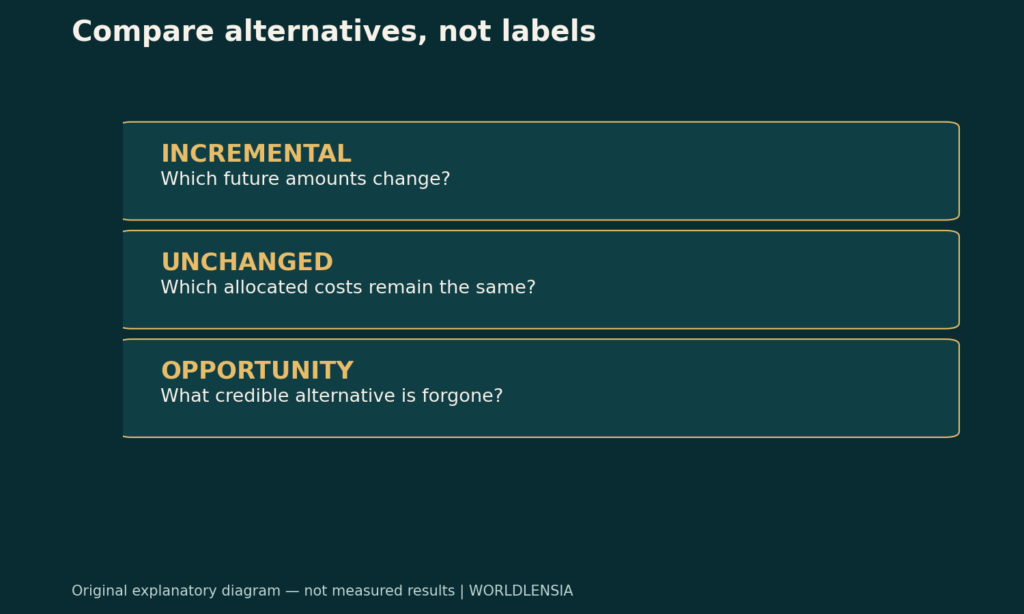
Allocated cost and incremental cost answer different decisions. A product can appear unprofitable after overhead is assigned to it, yet accepting one more order can still improve the business’s short-term result. The apparent contradiction disappears when the question changes from “What cost was allocated?” to “What changes between these alternatives?”
An allocation can be useful for reporting or long-term planning. It does not automatically identify the spending that a particular decision creates or avoids. Build the comparison around the decision window, the available capacity and the next-best use of the resources.
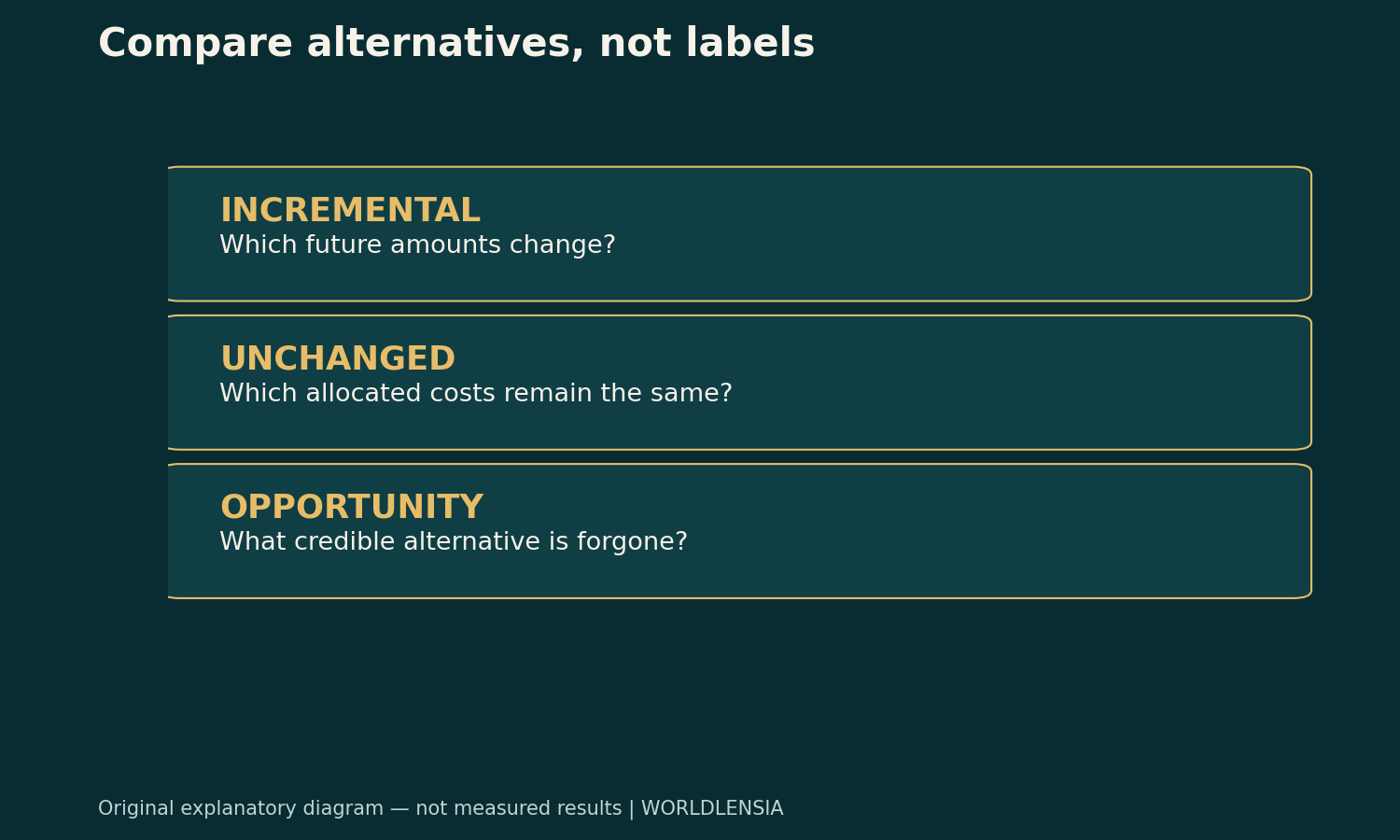
Begin with a precise alternative
“Should we take the order?” is incomplete until the alternative is clear. Does rejecting it leave equipment idle? Does accepting it displace a regular customer? Does it require an extra shift, a new supervisor or a different delivery commitment?
Choose the period as well. A facility expense may remain unchanged next week but become avoidable when a lease can be ended next year. Describing a cost as fixed without a time window can conceal the feature that matters for the decision.
OpenStax's managerial-accounting discussion defines decision-relevant information around differences between alternatives and separates sunk costs from future consequences. That principle provides the foundation. The scenarios below are original illustrations rather than copied textbook cases.
A fictional spare-capacity order
Suppose an extra order would generate $800 of revenue. Producing and delivering it requires $500 of additional materials and labor. The accounting report also assigns the order $400 of facility overhead, but that facility spending will remain unchanged whether the order is accepted or rejected.
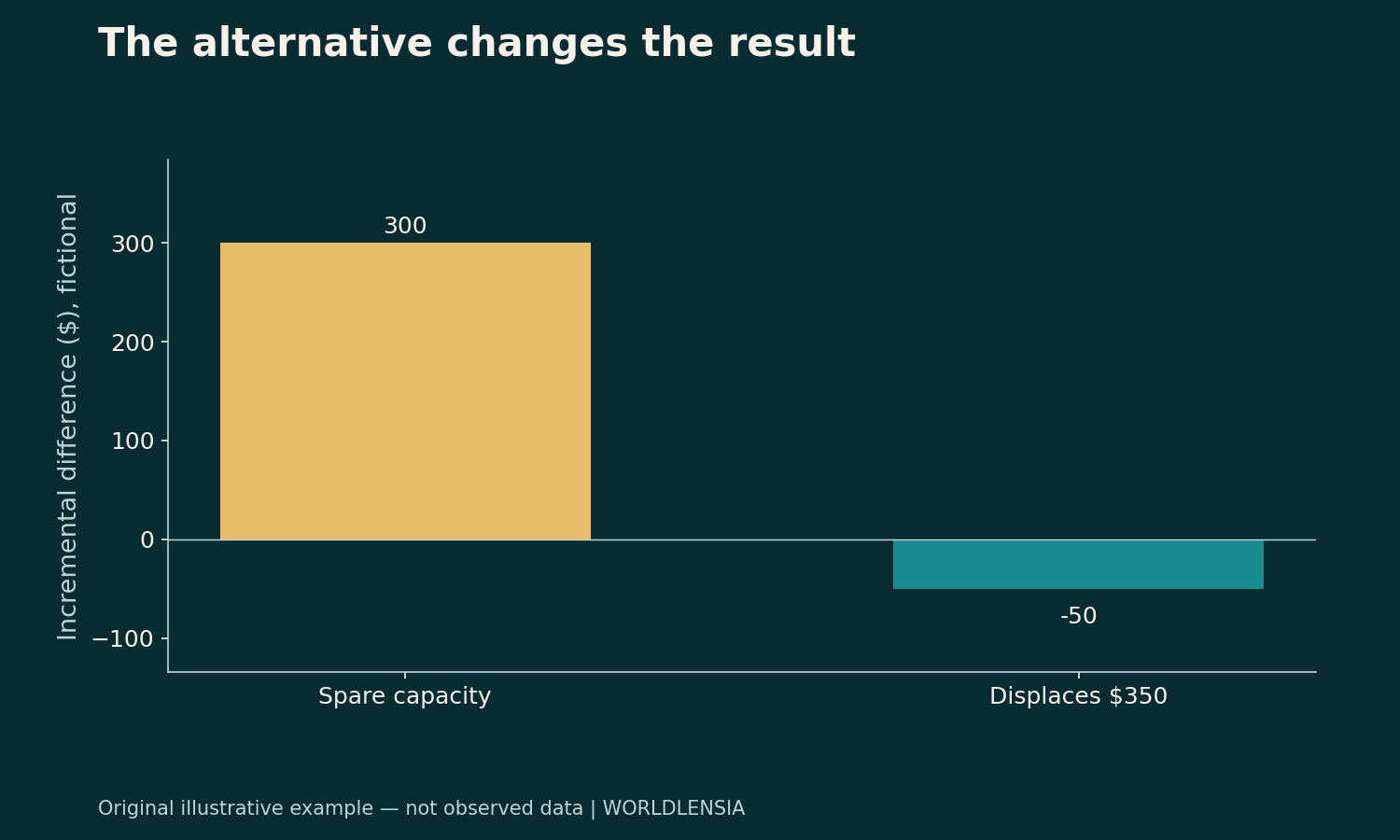
Under these narrow assumptions, accepting the order adds $800 and causes $500 of extra cost. The incremental contribution is $300. Subtracting the unchanged $400 allocation would answer a different reporting question and could hide the positive difference between the two alternatives.
| Synthetic item | Allocated reporting view | Change caused by this order |
|---|---|---|
| Revenue | $800 | +$800 |
| Additional materials and labor | $500 | −$500 |
| Assigned unchanged facility cost | $400 | $0 |
| Relevant short-term difference | Not the same measure | +$300 |
This is not evidence that selling below full cost is always sensible. It is a deliberately limited example with spare capacity and no omitted incremental consequences. A real decision needs evidence for each of those assumptions.
Capacity can reverse the conclusion
Now suppose the same order would use capacity that could otherwise generate $350 of contribution from another customer. Accepting it still produces $300 of incremental contribution before displacement, but it gives up the $350 alternative. Relative to that next-best use, the difference is negative $50.
Opportunity cost is not necessarily an invoice. It represents the benefit forgone when a scarce resource is used one way instead of another. Ignoring it can make a constrained operation look as though every positive-contribution order should be accepted.
Verify that the alternative is real. An imagined higher-margin order with no credible demand is not the same as a confirmed order that must be displaced. Record the evidence and the timing rather than inserting an optimistic opportunity-cost figure to obtain the preferred answer.
A fixed cost can become incremental
If accepting the order requires an extra supervisor for the shift, that additional expense belongs in the comparison even if it is called a fixed cost in another report. The label does not determine whether the amount changes.
Likewise, a cost described as variable may not increase over the relevant range if supplies have already been purchased and cannot be returned or used elsewhere. Investigate the actual alternatives. Classification should follow the decision's economics, not replace that investigation.
The capacity-utilization guide explains why the binding resource can differ from the busiest-looking machine. Identify the bottleneck before valuing spare capacity or displaced work.
Do not let sunk costs decide the future
Money already spent and unrecoverable is not changed by the next decision. It may explain how the business reached its position, but it does not become avoidable because an allocation places it on a new order.
Distinguish a sunk expenditure from a recoverable asset. If equipment can be sold, accepting an order may delay or prevent that sale; the recoverable value can be relevant. The fact that the original purchase is in the past does not make every future consequence of the asset irrelevant.
This is another reason to describe alternatives explicitly. “We already paid for it” is not a complete decision rule when the resource has another use or a resale value.
Short-term contribution is not a sustainable pricing policy
A business cannot indefinitely ignore the resources required to remain in operation. A spare-capacity decision can be positive over a short interval while the overall business still fails to cover facilities, management, replacements or other continuing needs.
Keep the decision note narrow: it identifies the change relative to the stated alternative, not the minimum sustainable price for every future sale. Examine customer expectations, contractual commitments, service quality and the risk of displacing regular demand.
The break-even guide answers the broader volume-and-cost question. Use it alongside the incremental analysis when the decision affects the continuing operating model.
A reviewable decision worksheet
For each revenue or cost line, record the amount under acceptance, the amount under rejection and the difference. Identify the source of the estimate and whether the amount is committed, avoidable, uncertain or an opportunity cost.
Add capacity assumptions, quality requirements, delivery deadlines and the decision window. Run a downside scenario for uncertain items. If the result depends on a small difference between uncertain estimates, say so rather than presenting a precise verdict unsupported by the inputs.
The useful conclusion is conditional: accepting the fictional order improves the short-term result by $300 only when capacity is genuinely spare, the $500 captures all additional costs and no better alternative is displaced. Change those conditions and the conclusion must be recalculated.
A decision table needs a baseline owner
Identify who confirmed the rejection alternative and the capacity assumptions. A calculation can be correct while its baseline is unrealistic. If accepting the order changes service commitments or displaces work that another team controls, verify those consequences before treating the difference as actionable.
Record unresolved inputs as uncertainties and show how they could change the result. The worksheet should support a decision, not conceal the judgments on which it depends.
Keep the assumptions with the result when sharing it.
Sources and methodology
Relevant-cost concepts were checked against OpenStax's decision-making chapter on October 19, 2026; a publication/update date for the section was not established in this review. All order amounts and capacity scenarios are original hypothetical examples. They are not accounting advice for a particular company or observed financial results.
To test the decision against break-even and capacity assumptions, see Break-Even Analysis: Test Price, Costs and Capacity Before Trusting the Sales Target and Capacity Utilization: A Busy Factory Can Still Have a Bottleneck.