
Quick answer: The USDA grocery budget for one person is about $305 to $584 per month for a single U.S. adult ages 20–50 in 2026, depending on the plan and adult category. The Low-Cost and Moderate-Cost benchmarks range from about $331 to $478 for the same age group. These figures are planning standards for food prepared at home, not a survey of what single adults actually spend.
Try the interactive tool: Use our USDA grocery budget calculator to compare food-at-home costs across all four plans. Both the calculator and this article currently use September 2026 USDA benchmarks. The calculator applies the household-size adjustment; the table below shows the adjusted amounts for one adult ages 20–50. Confirm the displayed source month whenever you compare results. The calculator displays household totals to cents; this guide rounds its table to the nearest 10 cents, so small display differences are expected.
This guide uses the latest USDA Cost of Food reports available on October 22, 2026: September 2026 for all four food plans. USDA updates food-plan costs monthly, so the report month matters when you compare grocery budgets.
USDA grocery budget for one person in 2026
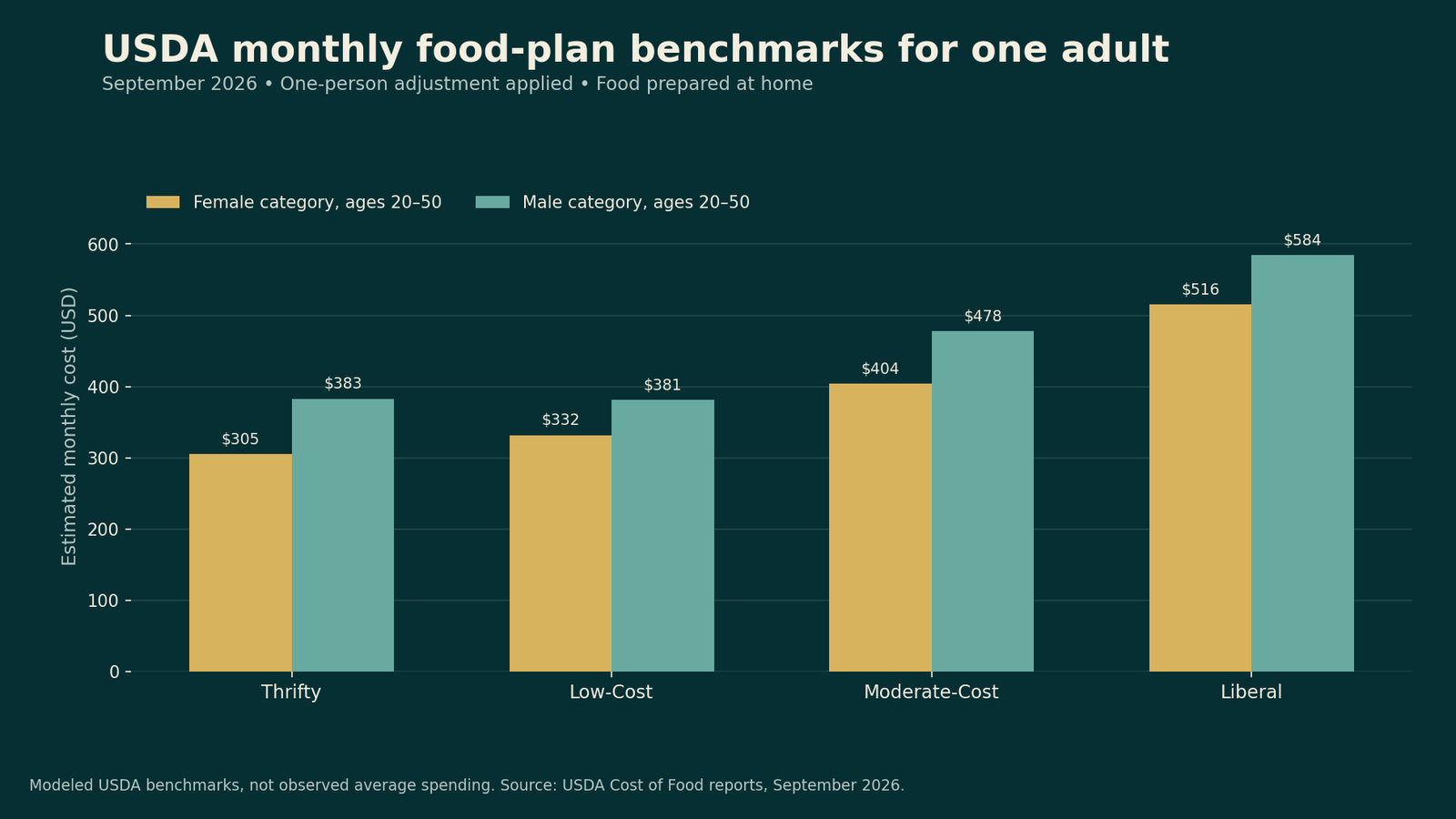
The USDA grocery budget starts with costs for age-and-sex groups using a reference four-person household. To estimate a one-person household, USDA suggests adding 20% to the listed individual cost. The table below applies that adjustment to adults ages 20–50. Weekly and monthly costs are rounded to the nearest 10 cents.
| USDA food plan | Report month | Adult category | Estimated weekly budget | Estimated monthly budget |
|---|---|---|---|---|
| Thrifty | September 2026 | Female, 20–50 | $70.30 | $304.70 |
| Thrifty | September 2026 | Male, 20–50 | $88.30 | $382.80 |
| Low-Cost | September 2026 | Female, 20–50 | $76.60 | $331.60 |
| Low-Cost | September 2026 | Male, 20–50 | $88.00 | $381.20 |
| Moderate-Cost | September 2026 | Female, 20–50 | $93.10 | $403.70 |
| Moderate-Cost | September 2026 | Male, 20–50 | $110.30 | $478.10 |
| Liberal | September 2026 | Female, 20–50 | $118.90 | $515.50 |
| Liberal | September 2026 | Male, 20–50 | $134.80 | $584.20 |
Source: USDA September 2026 Cost of Food reports for all four Food Plans. The latest available report month is shown for each plan.
What each grocery budget level means
- Thrifty: The lowest-cost USDA plan. It represents a nutritious food pattern at a constrained cost and generally assumes careful planning and meals prepared at home.
- Low-Cost: A step above Thrifty for a household seeking a modest grocery allowance.
- Moderate-Cost: A higher monthly benchmark that allows more flexibility in food choices.
- Liberal: The highest-cost plan in the USDA comparison, with a larger food budget.
These USDA grocery budget amounts are planning benchmarks, not instructions that everyone should spend a specific amount. Your own grocery total changes with local prices, diet, food waste, cooking access, and how many meals you eat at home.
How to calculate a grocery budget for your household
For one adult, start with the USDA’s age-and-sex amount and add 20%. For example, the September 2026 Moderate-Cost figure for a female adult ages 20–50 is $336.40 per month in the underlying four-person table. Applying USDA’s 20% one-person adjustment gives $403.68, rounded to $403.70. For a male adult in the same group, $398.40 becomes $478.08, rounded to $478.10.
For a two-person household, USDA suggests adding 10% after summing the individual costs. For a three-person household, add 5%; for four people, make no adjustment. For five or six people, subtract 5%, and for seven or more, subtract 10%. These adjustments account for differences in buying and preparing food across household sizes.
USDA monthly amounts are calculated from weekly costs using 4.333 weeks per month. That is why multiplying a weekly amount by four can understate a full-year monthly budget. A weekly allowance of $100 averages about $433 per month across a year.
What the USDA grocery budget includes—and leaves out
The Food Plans estimate food costs when meals and snacks are prepared at home. They are not an estimate of a person’s total food spending. Restaurant meals, takeout, delivery, and work lunches belong in a separate food-away-from-home total. Toiletries, cleaning products, paper goods, and other nonfood items are not groceries for this comparison either.
The USDA figures also are not the same as the average grocery spending reported by a household survey. The Bureau of Labor Statistics’ 2024 Consumer Expenditure Survey reported average annual spending of $6,224 on food at home across all consumer units—about $519 per month. That population includes households of different sizes, so it should not be treated as a one-person average or compared directly with the USDA’s modeled single-adult budgets.
Which number should you use?
To choose a USDA grocery budget, use the Thrifty or Low-Cost figure if you are building a lean food-at-home plan; use Moderate-Cost or Liberal as a higher comparison point. Track your actual food-only grocery purchases for four weeks, divide the total by four, and compare that weekly average with the weekly USDA benchmark. To estimate a monthly average, multiply your weekly average by 52 and divide by 12. If a shopping receipt includes household supplies, remove those costs before comparing it with the USDA table. Track restaurant and delivery spending separately so a lower grocery bill does not hide a higher total food bill.
Prices differ across the United States, and USDA’s national figures are not a state-by-state price quote. Treat them as a consistent national reference, then adjust your personal plan for the stores, foods, and meals available where you live.
Put the comparison into practice: Use our free grocery receipt worksheet for one person to split mixed receipts, record stock-ups and compare equal observation periods.
Method and sources
We used the USDA’s monthly Cost of Food reports. We used September 2026 costs for all four food plans. We multiplied individual monthly and weekly costs by the USDA’s suggested 1-person factor of 1.20 and rounded to the nearest 10 cents. For survey context, we used the BLS 2024 Consumer Expenditure Survey.
Explore more U.S. economic and personal-finance coverage in our Economy & Finance section.
Frequently asked questions
How much should one person spend on groceries per month in 2026?
The USDA’s one-person-adjusted benchmarks for an adult ages 20–50 range from about $304.70 to $584.20 per month across its four plans and adult categories. A more moderate comparison point is about $403.70 for a female adult or $478.10 for a male adult, using the September 2026 Moderate-Cost plan.
What is the USDA grocery budget for one person on the Thrifty plan?
For September 2026, the Thrifty estimate for one adult ages 20–50 is about $304.70 per month for the female category and $382.80 for the male category, after applying USDA’s suggested 20% one-person adjustment.
Does the USDA grocery budget include eating out?
No. USDA’s food-plan costs assume food is prepared at home. Restaurant meals, takeout, delivery, and other food-away-from-home purchases should be tracked separately.
Are these figures the average grocery bill for one person?
No. USDA food plans are modeled cost benchmarks. An average requires observed spending data and a defined survey population. The BLS survey figure cited here covers consumer units of different sizes, not single adults alone.
Food costs can rise faster or slower than the national average depending on what a household buys. Compare your grocery budget with our guide to personal inflation and CPI spending weights.