
Adding “human review” to an AI workflow does not explain what the reviewer sees, what they can change, or how much time they have. A person who approves hundreds of outputs without evidence or authority may add little protection. Effective review needs a defined decision, usable information, and a way to intervene.
NIST's AI Risk Management Framework and its Playbook provide resources for identifying responsibilities and managing risks in context. The Playbook is not a universal checklist. The practical design below is WorldLensia's own framework for a fictional editorial assistant, not a claim of NIST certification or a substitute for domain-specific obligations.
Human Review: Define what is being approved
For an editorial assistant, separate drafting from publishing. A model may prepare an article, but publication should depend on source checks, factual review, image rights, and a clear accountable decision. Reviewing a headline alone does not approve the article's underlying statistics.
Write the review question as an observable condition. “Looks good” is hard to audit. “Every numerical claim matches the cited source and comparison period” gives a reviewer something specific to test. Different checks can belong to different people or stages, provided responsibility is explicit.
Give the reviewer evidence
Show the source passage beside the claim, including date, units, and relevant qualifications. For calculations, provide inputs and formulas. For an image, retain origin and usage information. A polished output without these materials shifts the burden of reconstructing the entire research process onto the reviewer.
Evidence should also make disagreement possible. If the interface displays only a green confidence badge, the reviewer may be encouraged to accept a conclusion without checking it. A model's confidence wording is not an independent validation result.
Match review depth to consequences
| Workflow | Example review requirement | Important limit |
|---|---|---|
| Internal brainstorming | Relevance and obvious errors | Ideas are not verified facts |
| Public factual article | Source and calculation checks | Publication reaches readers |
| Account-changing action | Exact target and authorized action | Requires appropriate controls |
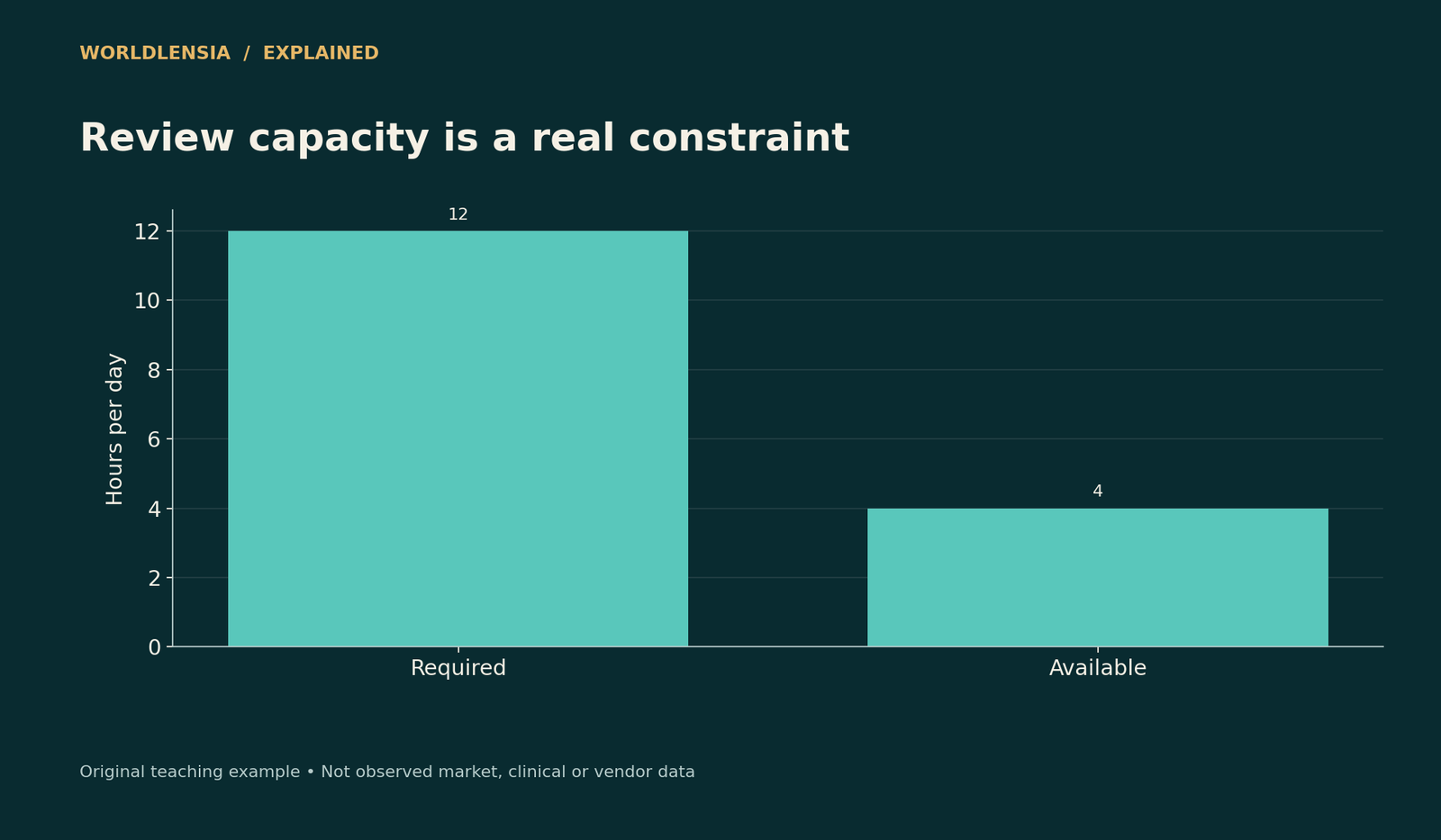
Figure data and assumptions
Original hypothetical teaching data; see the caption and article for assumptions.
| Category | Reviewer-hours |
|---|---|
| Required | 12.0 |
| Available | 4.0 |
These are design examples, not a legal classification. An organization should evaluate the actual consequences and applicable requirements. The same model-generated sentence can carry very different stakes in a private draft and a public medical claim.
Capacity changes the effectiveness of review
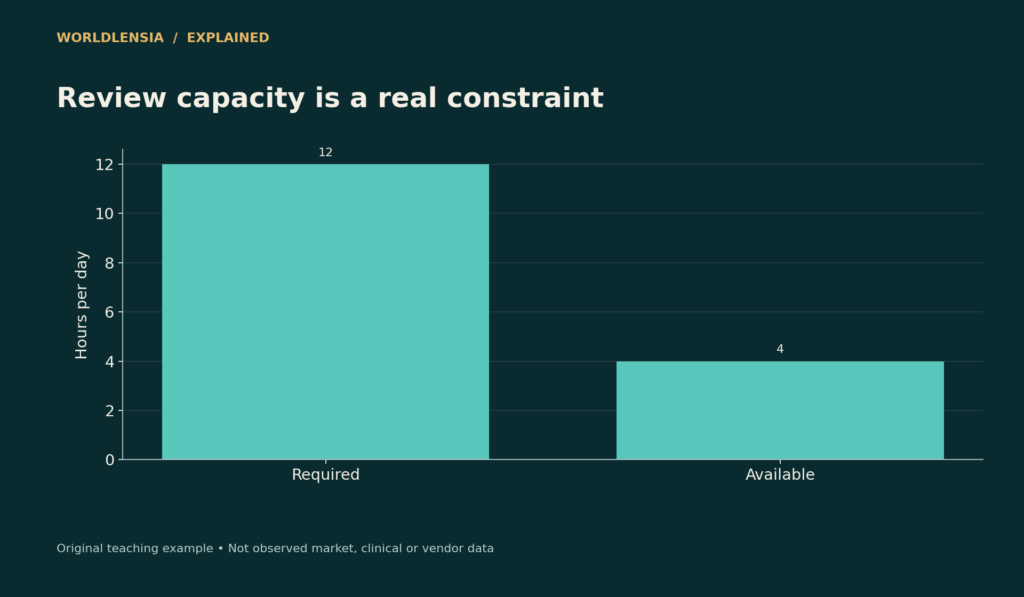
Suppose 60 drafts arrive each day and a meaningful review takes 12 minutes per draft. That requires 720 minutes, or 12 reviewer-hours, before breaks and other work. Assigning it to someone with four available hours does not make the process adequately reviewed.
If the queue grows by eight hours of work per day, the team needs to change staffing, scope, throughput, or the review design. Quietly reducing each review to a quick glance hides the constraint. The accompanying chart shows this hypothetical workload gap, not a recommended staffing ratio.
Use sampling with clear boundaries
Sampling can help assess recurring low-impact work, but a sample does not verify every unreviewed item. State what sampling establishes and what still requires individual review. Maintain a route for uncertain cases and defects found after release.
A sample drawn only from short, successful outputs will underestimate problems in long or failed outputs. Define the eligible population and include relevant sources of difficulty. Keep selection records so the audit can be repeated.
Preserve an independent judgment stage
For a pilot, ask reviewers to answer selected questions before seeing the model's conclusion, then compare with assisted review. This can help reveal whether the model changes judgment without improving correctness. It is an experiment, not proof that all review should always be blinded.
Record disagreements and why they were resolved. Distinguish a correct model answer rejected by a reviewer from a model error caught by review. The performance of the combined system depends on both kinds of event.
Make intervention real
A reviewer needs authority to reject, revise, request evidence, or pause the workflow. Provide an escalation owner and a rollback path. If publication proceeds automatically regardless of a warning, the review is advisory and should be described that way.
Keep the approved version. If the draft changes afterward, the approval may no longer apply. Version identifiers, timestamps, and change summaries make this easier to manage without relying on memory.
Separate checking from rewriting
A reviewer can spend substantial time improving style while overlooking whether the central claim is true. Give factual validation, calculation checking, and copy editing distinct objectives, even if one person performs all three. A fluent rewrite should not erase the original source trail.
For an article containing a comparison, first verify that the units, populations, and periods match. Then reproduce any calculation. Only afterward improve the wording. If a corrected fact changes the argument, revisit the conclusion instead of making a local number substitution and leaving the interpretation unchanged.
Keep revisions visible enough to audit. A reviewer should be able to identify which claim changed and whether a new source was introduced. This is particularly important when several drafts are combined into one publication batch.
Test the reviewer interface
Give reviewers a small set of deliberately constructed cases containing different defects: a correct quotation linked to the wrong document, a percentage calculated from the wrong denominator, an outdated policy, and a chart with mismatched units. These are training exercises, not real published errors.
Observe whether the interface makes each defect discoverable. If the source link is hidden or the chart lacks a data table, reviewers may struggle despite understanding the subject. Improve the evidence presentation rather than assuming the solution is simply more vigilance.
Also include correct cases. An interface that encourages rejection of everything is not necessarily effective. The goal is reliable discrimination and appropriate escalation, not maximum disagreement with the model.
Manage uncertainty explicitly
A reviewer may find that the available evidence does not support a confident answer. Provide a legitimate “hold” or “needs further research” state. Forcing every item into approve or reject can encourage unsupported judgments when the right outcome is more investigation.
Specify what is missing and who can resolve it. “Uncertain” without a reason is difficult to act on. “The source gives a national total but the headline claims a city total” creates a concrete next step: find suitable local evidence or revise the scope.
Do not convert a research gap into an invented estimate merely to meet a daily quota. Throughput is a planning target. Publication readiness is a separate decision that depends on the evidence in the actual article.
Recheck after material changes
If an approved article later receives a new chart, new figures, or a stronger claim, the earlier approval does not automatically cover that addition. Define which changes require renewed checks. A corrected typo and a changed economic conclusion need different review effort.
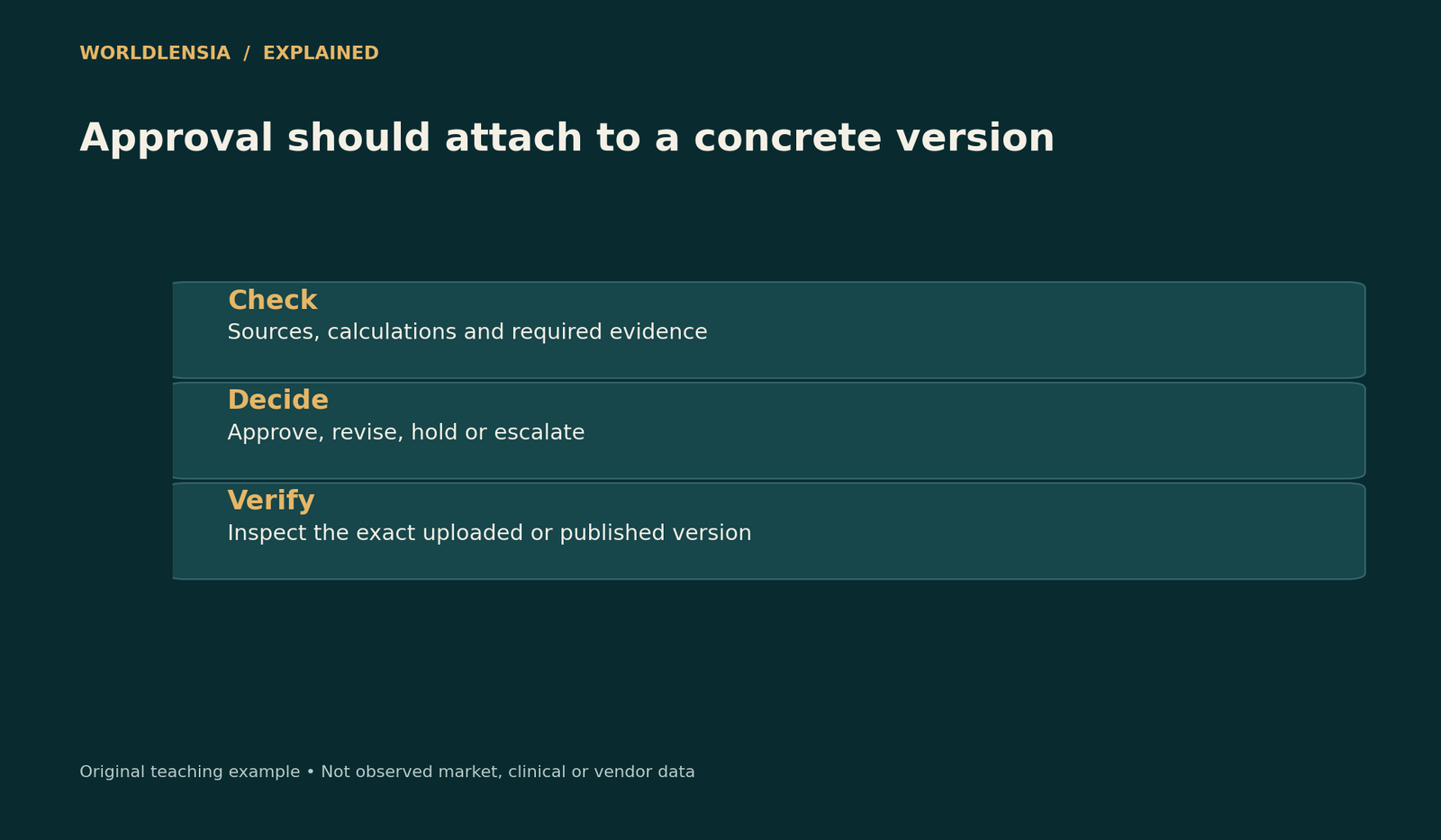
Preserve the final approved version and the publication record. If the publishing system changes formatting, inspect the resulting page for missing tables, truncated captions, broken source links, and misplaced decimal signs. Content validation before upload does not guarantee correct rendering afterward.
The same principle applies outside publishing. A model-generated action can change after an approval if tool inputs are recomputed. Review should attach to the concrete action and target, not to a vague description that later evolves.
Use incidents to improve the process
When a defect escapes, trace where it should have been detected. Was the original evidence absent, the reference misunderstood, the calculation unchecked, or the published version different? Different causes require different remedies.
An incident log should support correction rather than encourage concealment. Record the affected output, discovered issue, correction, reader impact where known, and process change. Avoid declaring the problem solved solely because a checklist received another item.
Revisit a sample of later work to see whether the remedy helped. Human review is a system to evaluate over time, not a one-time label attached during launch. Its value is demonstrated by better outcomes and clear accountability.
Make the final status understandable
Use separate states for drafted, checked, approved, scheduled, and published. Each should correspond to observable evidence. A file that exists locally has not necessarily been uploaded, and an uploaded draft has not necessarily been made public.
The review record should identify the final version and any outstanding limitations. If a source could not be accessed or a calculation remains unresolved, keep the item on hold. This makes workload planning more realistic and prevents a preparation milestone from being reported as completed publication.
Measure the result
Track defects caught before release, defects discovered afterward, review time, queue age, disagreement rates, and the kinds of cases escalated. Avoid rewarding reviewers only for speed or agreement with the model. Those incentives can undermine the purpose of review.
For WorldLensia-style publishing, a useful acceptance record connects each article to its sources, checked calculations, image captions, and final version. Pair this with the citation-audit guide and the classifier evaluation guide. Human review should be a testable part of the workflow with visible limits, not a phrase used to imply that errors are impossible.
Protect the meaning of approval
An approval should identify what was checked and by whom or by which process. It should not imply expertise the reviewer does not possess. For a specialized health or legal claim, editorial clarity alone does not establish domain validity. Keep unresolved specialist questions visible and narrow or hold the claim when the evidence is insufficient. A review process can be useful without claiming that it removes every risk. Its credibility comes from observable checks, correction behavior, and an accurate description of its limits, rather than a generic statement that a human looked at the output.
Sources and methodology
NIST AI RMF resources and the Playbook were checked October 18, 2026. The publishing workflow, review questions, and staffing example are original analysis. No claim is made that NIST endorses these particular procedures.
- NIST: AI RMF Playbook — checked October 18, 2026.
- NIST: Human-AI interaction — checked October 18, 2026.
Continue with Citation audit worksheet and Evaluate task success for related context.
To make review decisions traceable to evidence, see AI Answer Review Worksheet: Check Answers Against Evidence and Build an AI Citation Audit: A Source Ledger That Catches Gaps.