
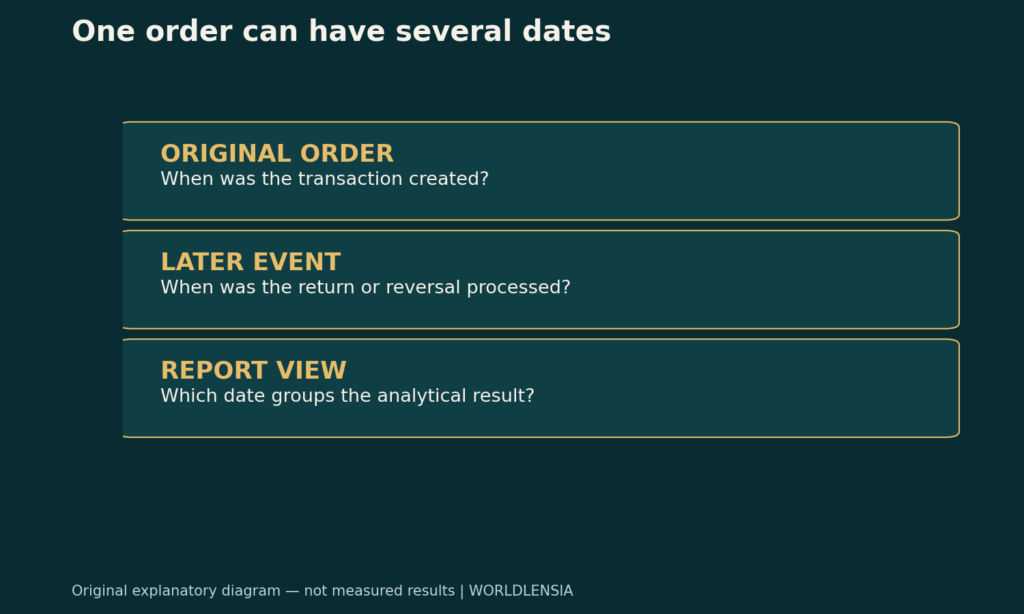
A reporting date determines how a sales chart assigns returns and reversals to an order period. An adjustment may be recorded when it is processed rather than on the original order date. That does not make the report wrong. It means the chart is organizing events by a particular time rule.
Before explaining a decline or comparing customer groups, identify whether the report follows transactions as they happen or revisits the orders to which they belong. Those views can answer different questions and produce different monthly patterns from the same underlying activity.
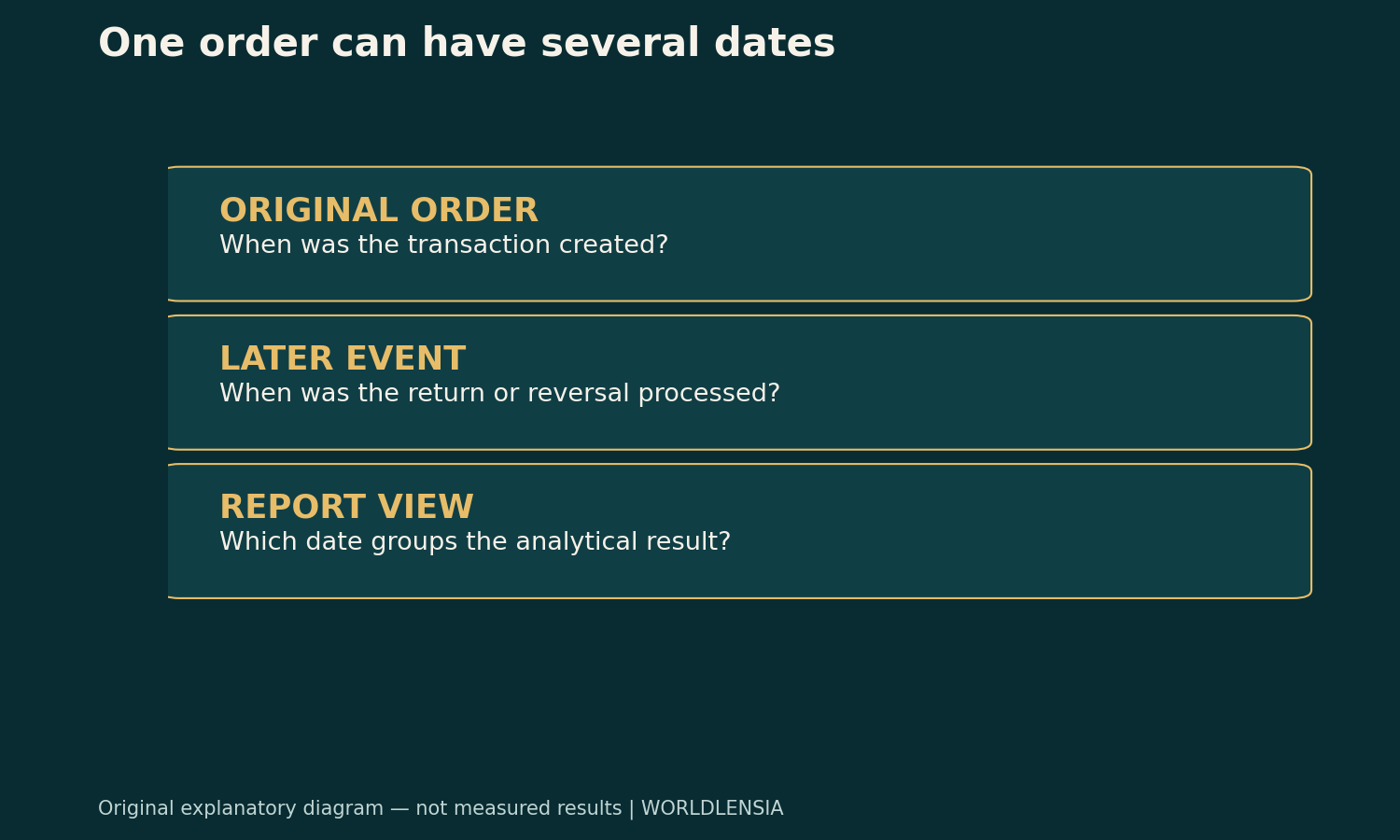
Separate events before choosing a reporting date
An order can be placed on one day, an item returned later, a refund processed after that and a report updated on another date. A physical return and a financial reversal are related but are not automatically the same event or amount.
Define the fields in the system being used. Record whether an adjustment represents returned quantity, a refund, an edit, an exchange or another reversal. Do not assume that every negative sales line means the same thing.
Shopify's sales-report documentation is one primary source for platform-specific definitions and adjustment treatment. Those conventions should not be generalized to every commerce platform or to every accounting report. A named report and its current documentation are more useful than a broad statement about what “sales” always means.
A fictional order across two months
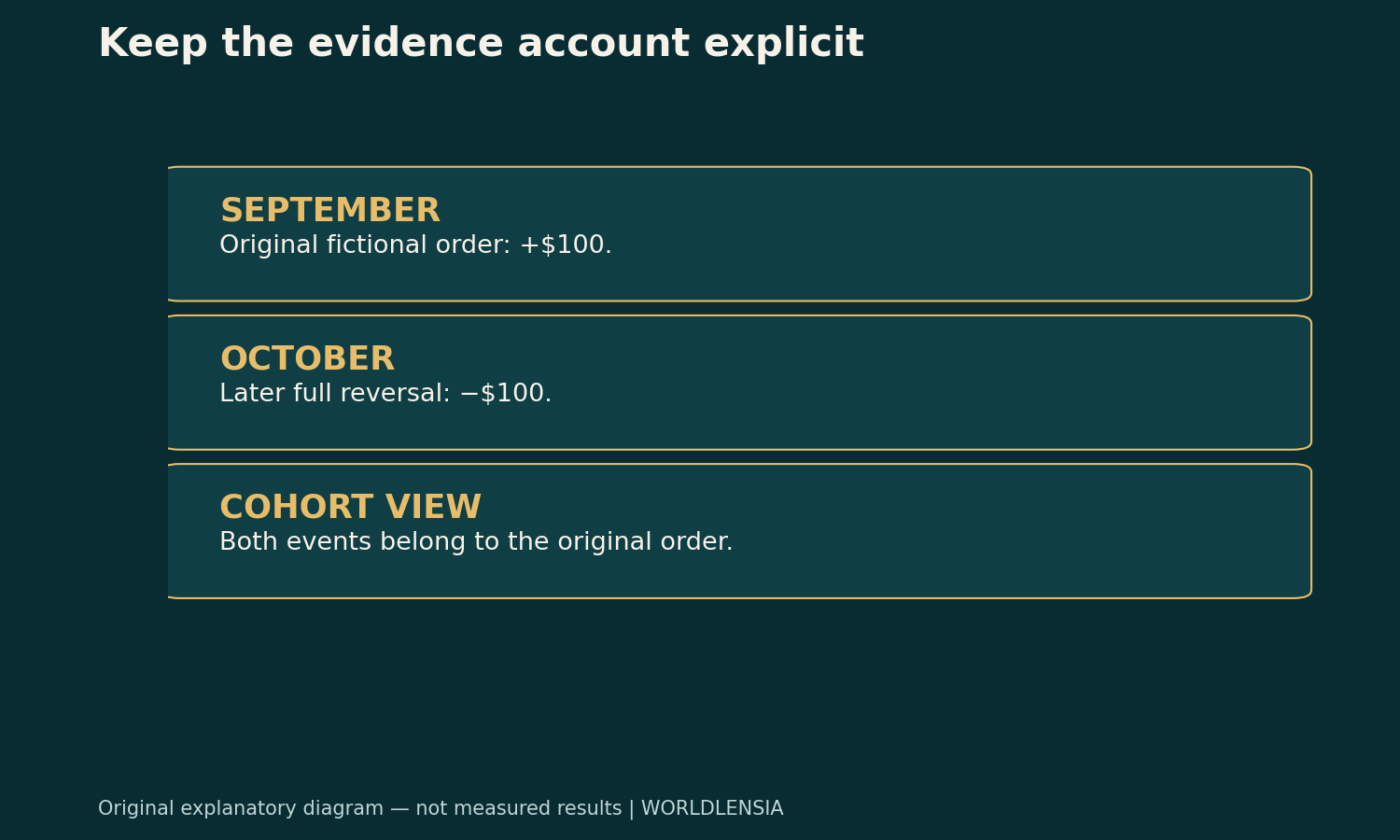
Imagine a $100 product order placed in September. In October, the order is fully reversed in the simplified account. There are no taxes, shipping charges, fees or partial adjustments in this example.
One view records the original positive event in September and the negative event in October. Another groups both events with the September order, revising that order cohort's net amount to zero.
| Synthetic view | September | October | Combined net |
|---|---|---|---|
| Processing-date event view | +$100 | −$100 | $0 |
| Original-order cohort view after adjustment | $0 | No new order in this example | $0 |
The combined account agrees, but the monthly pattern differs. The second row is not a claim that every Shopify report retrospectively displays this exact layout. It is an original illustration of two possible analytical views.
Each time rule answers a different question
A processing-date view can help describe what adjustments the business handled during a period. An original-order view can help compare the eventual net outcome of orders acquired in a period. Neither automatically substitutes for the other.
For example, an operations team may care about the volume of returns processed this week. A marketing analysis may care about the later outcome of customers or orders acquired during a campaign. Matching the time rule to the question prevents one team from treating another team's valid report as contradictory.
Write the rule in the report title or nearby note. “Adjustments processed in October” is clearer than an unlabeled “October returns” if the distinction affects the interpretation.
A negative month need not identify a new demand collapse
In the fictional processing-date account, October contains a negative $100 adjustment and no new sale. That does not prove that October customers changed their behavior. The underlying order originated in September.
For a real report, investigate the order dates and processing dates before assigning a cause. A large adjustment could relate to earlier activity, a batch of records or a changed reporting convention. Which explanation applies requires transaction evidence.
Do not dismiss a negative movement simply because timing can matter. The adjustment is still economically relevant. The point is to describe what happened and when, rather than using the chart's month label to invent the originating behavior.
Reconcile quantities and money separately
A returned item count does not establish the amount refunded. Discounts, partial returns, exchanges and other adjustments can affect the relationship. Likewise, a refund may occur without a physical item re-entering usable inventory.
Build separate accounts for the physical and financial events when both matter. Record the quantity, item identifier, amount, event type and date. Check how the source treats canceled orders or edits rather than assigning them to a return category by assumption.
Do not present the operational reconciliation as a prescription for financial accounting. A business's reporting obligations and policies require their own evidence. The purpose here is to keep analytical measures from silently combining unlike events.
Cash timing is another layer
The date a sales adjustment appears in an analytics report may differ from the date cash moves. Payment processing, settlement and refunds can have their own event records. A sales-report line should not automatically be described as a bank cash flow.
If the question concerns liquidity, use the relevant payment and account records, with a clear scope. If it concerns demand or order outcomes, use a compatible sales or order view. The same underlying order may need to appear in several linked records because each answers a different question.
This separation is especially important when a report combines an original sale with later changes. A net amount can summarize the financial effect without showing the sequence of cash availability.
Cohorts require a complete observation window
Recent order cohorts have had less time to accumulate returns or adjustments than older cohorts. Comparing their final-looking net values without noting that difference can favor the newer group simply because its outcomes are incomplete.
Choose a consistent follow-up window when the question requires it. For instance, compare adjustments observed within the same number of days after each order, using actual data and a stated method. Do not invent an adjustment allowance to make cohorts comparable.
The customer-cohort retention guide addresses the related need to follow the same starting population. Here the additional issue is which events and follow-up periods enter that population's outcome.
Preserve revisions without losing the original record
Keep a raw event ledger and a versioned analytical view when possible. If a later adjustment changes an earlier cohort, record the update date. A saved report from last month may differ from a current report of that same month for a legitimate reason.
That difference should be explainable. A reviewer should be able to trace the changed total to added, edited or reversed events rather than being told only that the dashboard is “dynamic.”
For exported data, preserve the report definition and extraction time. If a platform changes terminology, document the old-to-new mapping before combining files. A similar column name is not enough to establish that its contents remained identical.
Connect returns to an operating model carefully
Returns can affect contribution through refunded revenue, processing work, shipping, damaged inventory or other consequences. Those effects should be modeled from evidence relevant to the business rather than a universal assumption that every return has the same cost.
The break-even guide explains how returns and defects can enter an operating scenario. This article addresses a different step: choosing the dates and definitions that make the inputs interpretable before they enter the model.
Avoid counting the same effect twice. If a revenue input is already net of a particular reversal, subtracting that reversal again as a separate revenue reduction would distort the account. The correct treatment depends on the selected definition, so label every input.
A reviewable reporting note
Before publishing a comparison, identify the report, platform, definition date, observation window and grouping rule. State whether adjustments are shown when processed or assigned to original orders. Explain whether recent cohorts remain incomplete.
For the fictional example, the precise conclusion is that one $100 order and its later full reversal net to zero, while the monthly pattern depends on the time rule. Any claim about a real business's demand, customer satisfaction or profitability needs additional evidence.
That is the value of separating the events: the numbers become easier to reconcile, and the narrative becomes less likely to confuse a reporting convention with a newly observed change in behavior.
Order identifiers make the reconciliation possible
Use stable order and adjustment identifiers when the system supplies them. A date and amount alone may not reliably connect a reversal to the original transaction, particularly when many orders have the same value.
Keep one-to-many relationships visible. One order can have several later adjustments, and one operational batch can contain events from many order periods. Flattening those relationships without a rule can duplicate revenue or omit an adjustment.
Before interpreting totals, verify that the join between orders and events preserves the intended number of records. A reporting-date explanation cannot repair a duplicated data merge.
Distinguish finality from the latest available view
A cohort reported today may still receive future changes. Label the extraction date and observation window rather than calling the net value final without a defined closure rule. The appropriate closure rule depends on the business process and analytical purpose.
For a comparison, use compatible maturity windows or clearly explain the difference. An older cohort's more complete history should not be compared with a new cohort as though both had equal opportunity to accumulate reversals.
That is a data-status issue as well as a timing issue. A current dashboard can be accurate about what is known now while remaining incomplete about the eventual outcome.
A chart can show both views without conflating them
Use separate panels for processing-date activity and original-order outcomes when both are relevant. Label each panel's time rule and keep the combined reconciliation nearby. This helps readers understand why a negative processing month can coexist with a revised earlier cohort.
Do not stack the two views as if they were separate amounts to add. They are different organizations of related events. Summing them would count the same underlying activity twice.
Keep a dated reconciliation note
When a material reporting difference is resolved, save the explanation with the affected period and event identifiers. That prevents the same timing question from being investigated repeatedly and lets another analyst verify the conclusion without reconstructing it from memory.
Sources and methodology
Platform terminology was checked against Shopify's sales-report documentation on October 19, 2026. Its publication/update date was not established in the retrieved page. The cross-month order, analytical views and reconciliation examples are original fictional teaching material, not an exact simulation of every platform report, an observed merchant result or accounting advice.
To reconcile reporting dates with contract timing and customer cohorts, see Bookings, Billings and Revenue: Three Dates in One Customer Contract and Customer Retention: Follow the Same Cohort Before Celebrating Growth.