
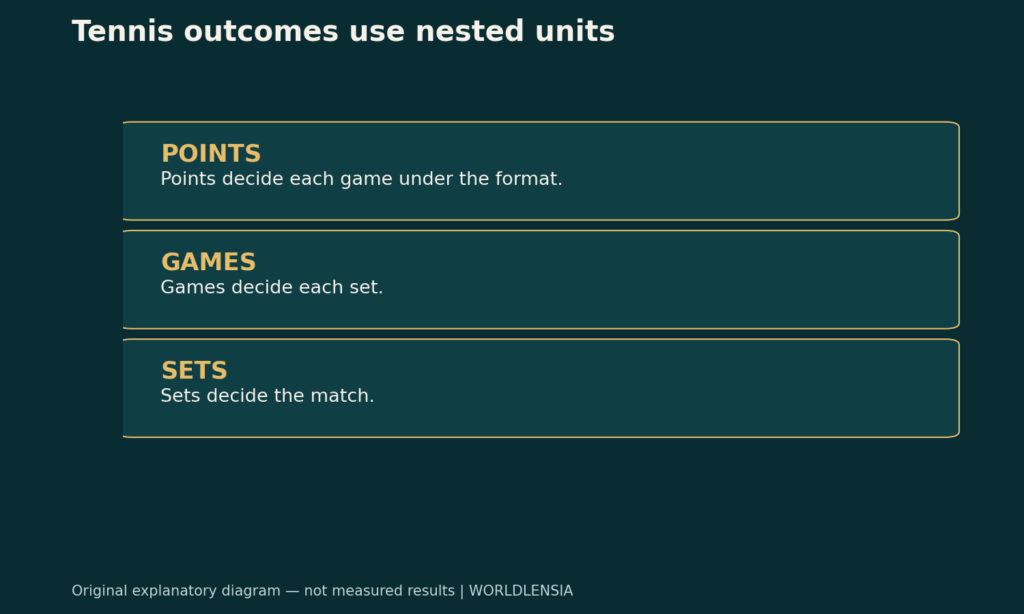
Winning more tennis points does not guarantee winning the match. Tennis does not decide a match by adding every point into one continuous total. Points decide games, games decide sets, and sets decide the match under the chosen format.
That structure makes the distribution of points important. Winning a game by a wide margin does not create a reserve of points that can be transferred to the next game. A player can dominate some games and narrowly lose enough others to lose the set.
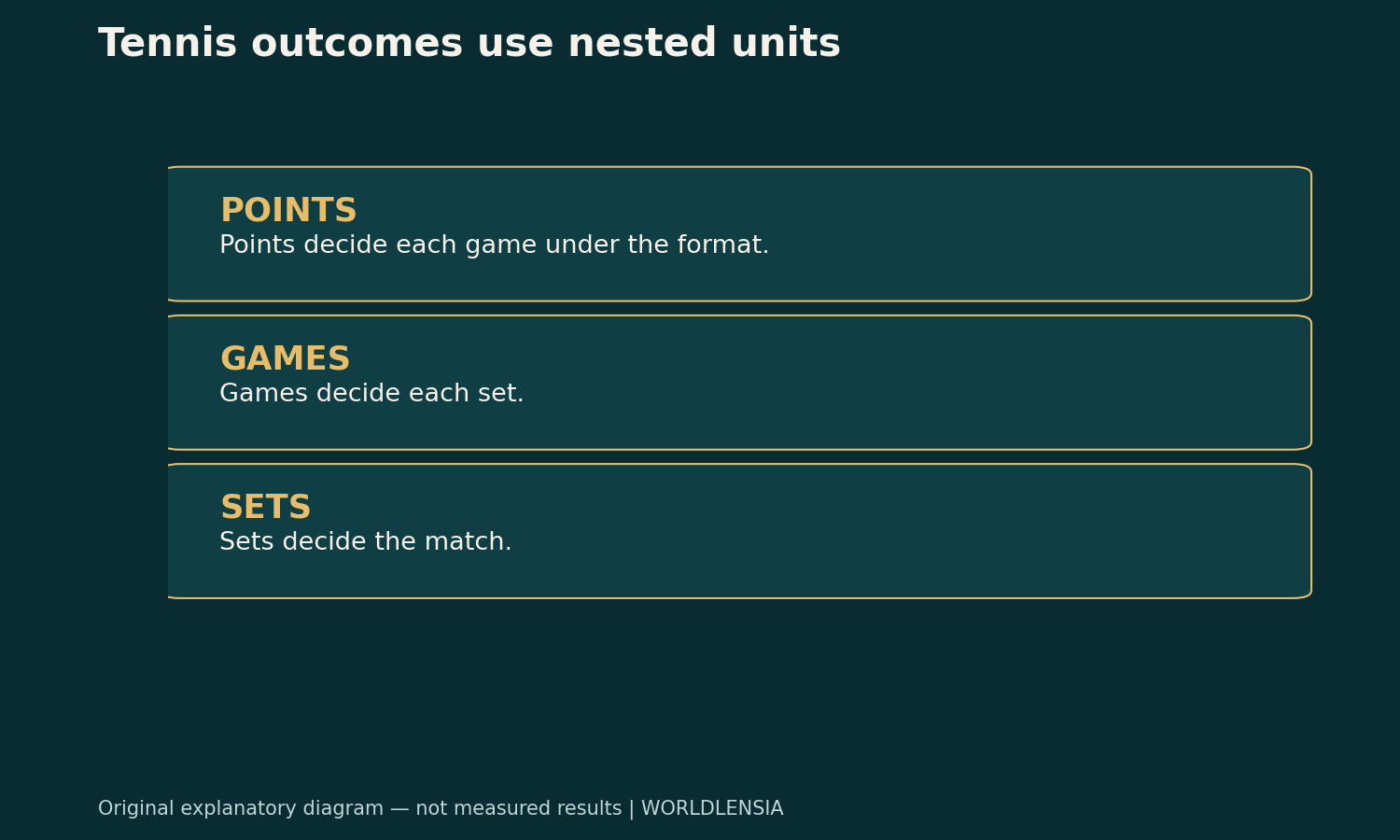
Tennis points, games and sets are separate scoring units
The ITF's 2026 Rules of Tennis describe scoring in games, sets and matches, including different permitted formats. For the example here, use conventional advantage games and a best-of-three-set match. Both sets end 6–4, so no set tie-break is needed.
An ordinary game can end with the winner having won four points and the loser two. It can also end four points to zero. These are point counts within a completed game, not the familiar display labels such as 40–30 or 40–0.
Those two legal game patterns are enough to build a complete illustration. No unusual rule, disputed point or statistical model is required.
A fictional straight-sets match
Player A wins each set by six games to four. In every game A wins, the point count is four for A and two for B. In every game A loses, A wins no points and B wins four.
For one set, A's six game wins contribute 6×4=24 points. A's four game losses contribute zero. A therefore wins 24 points in the set.
B wins two points in each of the six lost games, giving 12. B's four game wins contribute another 16. B wins 28 points in the set, despite losing it 4–6 in games.
| Fictional result | Player A | Player B |
|---|---|---|
| Points in each set | 24 | 28 |
| Games in each set | 6 | 4 |
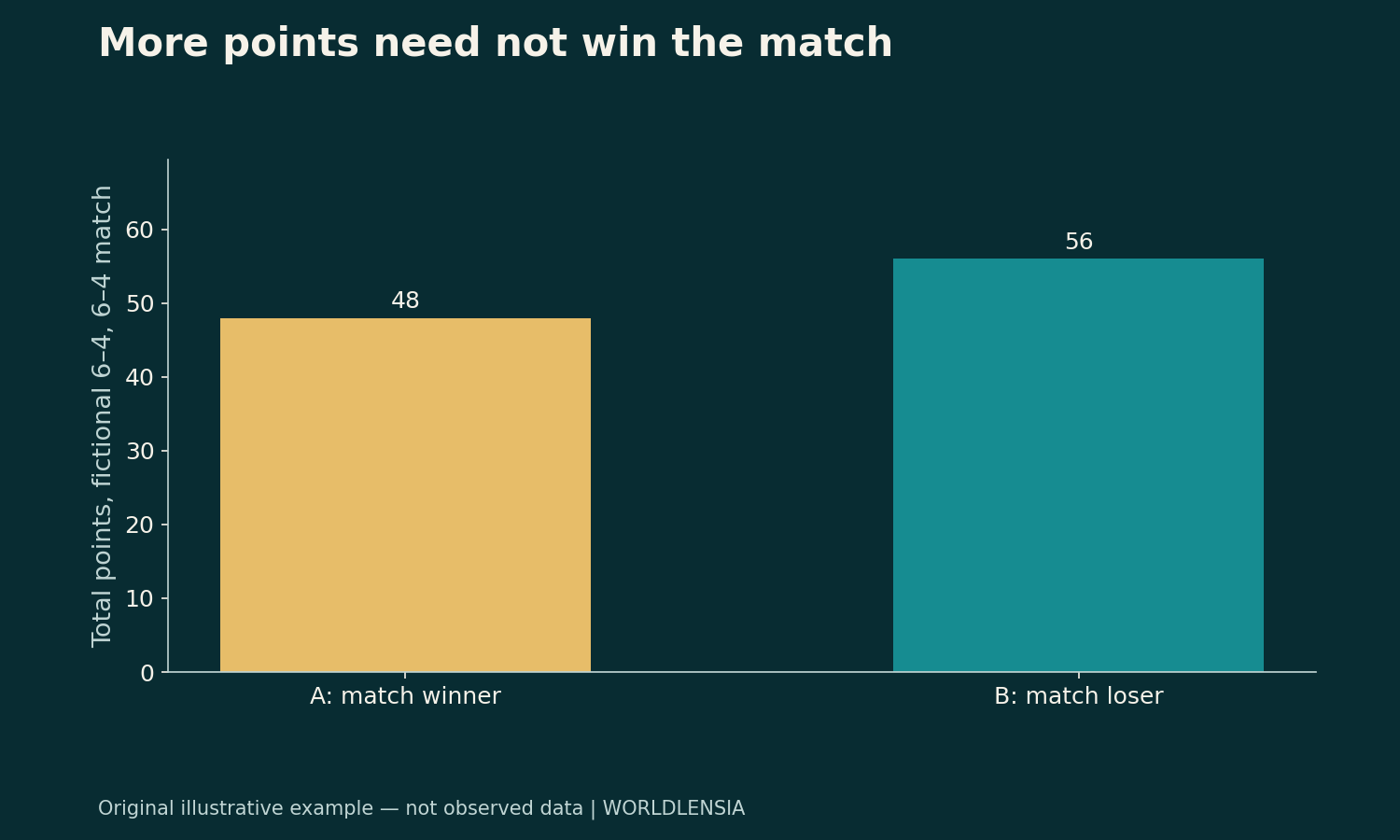
| Points across two sets | 48 | 56 |
| Sets won | 2 | 0 |
A wins the match 6–4, 6–4 while B wins 56 of the 104 total points, about 53.85%. Every game fits the stated scoring rules. The point advantage is concentrated in games that B already wins, while A wins more games overall.
The “extra” points do not carry forward
Compare a four-to-zero game with a four-to-two game. Each produces one game for its winner. The larger margin does not produce an additional game, nor does it cancel a game lost later.
This is a general reason that an aggregate performance total need not match the official outcome. The total and the outcome summarize different structures. That does not make either calculation wrong; it means they answer different questions.
The example is deliberately simple and synthetic. It does not claim that this pattern is common or describe any real player's style, mental strength or performance under pressure. Point totals alone cannot establish why a player won particular games.
Format matters before interpretation
A deciding match tie-break, a no-ad game or another permitted format changes how points become outcomes. Name the competition's format before using a worked example to explain its result. Do not automatically apply a conventional best-of-three calculation to every event.
When reporting a real match, verify the official score and point statistics separately. Note whether the point total covers the complete match and how any retirement or unusual ending is treated. A percentage without the match context can invite a conclusion that the underlying record does not support.
WorldLensia's winning-percentage guide explains a related distinction between a record and a broader assessment of performance. The percent-versus-percentage-point guide helps describe numerical differences accurately.
A clearer way to write the result
For the fictional match, a precise summary is: “A won both sets 6–4, while B won 56 of the 104 points.” That statement preserves the official outcome and the aggregate statistic without pretending one invalidates the other.
Avoid saying B “really won” because the point total was higher. The players competed under a scoring system that groups points into games and sets. Use total points as additional context, then investigate the distribution if the question is how the result developed.
Margin and outcome serve different summaries
Total points can be useful context about how a match unfolded, while sets determine the winner under the format. Keep both measures when they help the question, but do not substitute an analyst's preferred aggregate for the competition's stated scoring rule.
Sources and methodology
Scoring structure was checked against the ITF 2026 Rules of Tennis on October 19, 2026. The match, game patterns, counts and percentage are WorldLensia's original fictional example. No real match result, player assessment or betting claim is made.
To distinguish scoring units from other summaries of sporting performance, see Winning Percentage: Compare the Record, the Sample and the Rules and Batting Average vs On-Base Percentage: Walks Change the Comparison.