
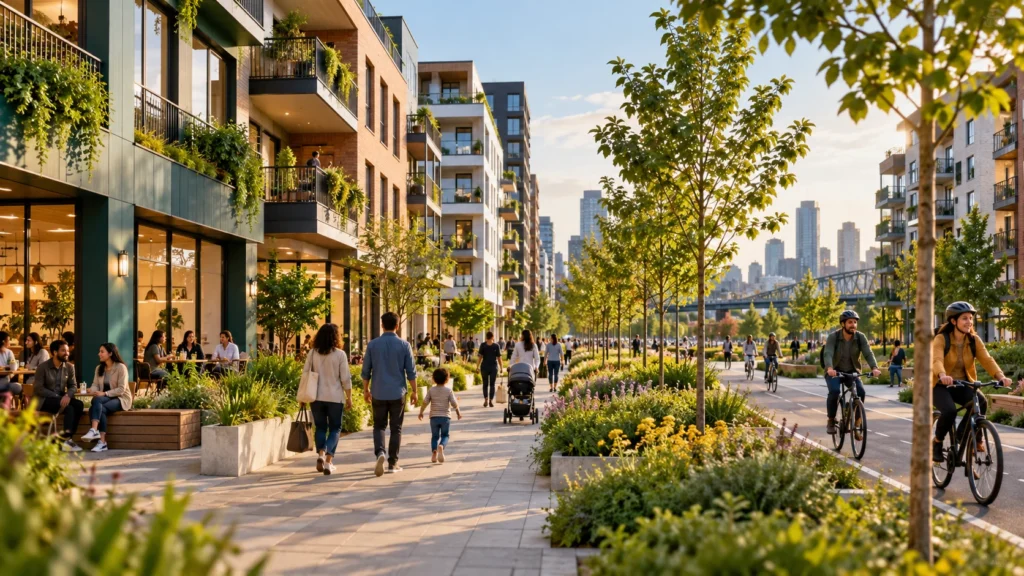
A renovated street can look impressive while leaving an important question unanswered: has life actually improved for the people who already live there? That question is central to the housing discussion ahead of World Cities Day on October 31, 2026.
As of October 16, cities and residents have a timely opportunity to look beyond construction announcements and ask how regeneration will be evaluated. A useful assessment starts with households, services and access rather than a photograph of a finished building.
Key points
- UN-Habitat lists the 2026 theme as Regenerating the City: Adequate Housing for All.
- The global observance is scheduled for Fuzhou, China, on October 31.
- WorldLensia’s checklist below is an analytical tool, not an official city ranking.
What is the focus of World Cities Day 2026?
The official UN-Habitat event page connects urban regeneration with housing and informal-settlement strategies. It highlights community participation, climate resilience and safeguards against displacement. The emphasis is therefore wider than replacing old buildings: it includes who shapes a project and who benefits from it.
Start with a before-and-after question
Choose the group whose outcome you want to understand. Existing renters, homeowners, small shopkeepers and people with mobility limitations may experience the same development differently. Combining them into an average can hide the trade-offs that matter most.
Next, define the starting point. Record the project boundary, baseline date, household group and information source. If a later announcement uses a different area or population, flag that change. Otherwise, an apparent improvement may partly reflect a change in what was counted.
Five tests that make regeneration easier to evaluate
| Test | Question to ask | Evidence to request |
|---|---|---|
| Affordability | Can existing households manage the full cost of living there? | Housing, utility and transport costs for the same household groups |
| Stability | What happens to residents during and after construction? | Published relocation and return arrangements |
| Daily access | Can people reach the places they need? | Door-to-door routes to work, education, care and shops |
| Usability | Does the neighborhood work for different residents? | Access audits and feedback from residents with varied needs |
| Accountability | Can problems be reported and tracked? | A named contact, response process and published outcome measures |
These are suggested questions, not a legal test or certification. They help readers identify missing information before treating a project announcement as proof of success.
Why the rent alone can be misleading
Consider two hypothetical neighborhoods. In each, a household earns $3,000 per month and pays $900 in rent. In Neighborhood A, utilities cost $180 and transport costs $120. In Neighborhood B, utilities cost $100 and transport costs $350.
The combined monthly cost is $1,200 in A and $1,350 in B: respectively 40% and 45% of the assumed income. These are invented examples calculated by WorldLensia, not observations about an actual city and not a recommended affordability threshold.
The lesson is about measurement. A comparison that records rent but ignores travel can produce a different conclusion from one that measures the whole household outlay. Explain which costs are included before publishing a claim about affordability.
How to read an urban improvement announcement
Separate commitments from outcomes. “Homes planned,” “homes under construction” and “homes occupied” should sit in separate rows. Ask whether a stated benefit is funded, contractually specified, completed or independently checked. Those stages should not be treated as interchangeable.
Also ask whether residents had a meaningful way to respond before the design was finalized. Publishing the number of meetings does not, by itself, explain whether feedback changed the plan. A more informative account identifies the concerns raised, the changes made and the concerns still unresolved.
Questions to revisit after October 31
A practical follow-up is to return to the same five tests at a stated interval. Are costs still reported on the same basis? Are temporary arrangements still temporary? Can residents find the information without specialist knowledge?
World Cities Day provides a useful moment for discussion, but the strongest evidence of regeneration comes from a consistent account of daily life over time.
Related topics: housing and real estate and public services and health data.
Method: Event details checked against UN-Habitat on October 16, 2026. The checklist and household-cost example are WorldLensia analysis; they do not rank or score any city.
To check housing outcomes alongside an urban-regeneration claim, see Comparing City Rents: Asking Rent, Contract Rent and Gross Rent Answer Different Questions and Rental and Homeowner Vacancy Rates Use Different Inventories.
Sources
Sources checked October 16, 2026. AI assisted drafting and illustration; cited source facts were checked separately.