
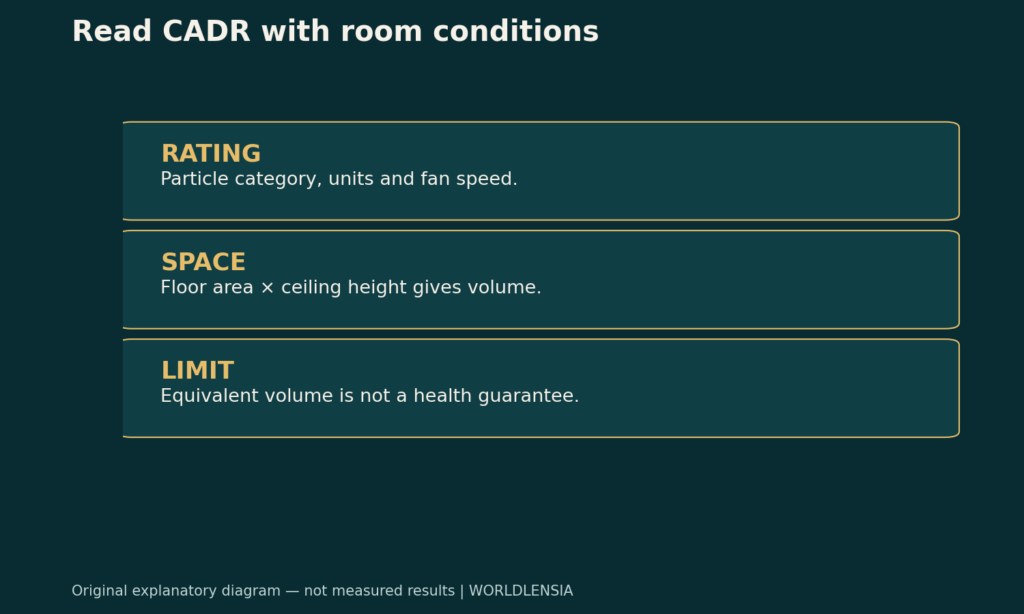
An air cleaner’s CADR (clean air delivery rate) is useful only when the comparison includes the space and operating conditions it is meant to serve. A large number on a box does not, by itself, establish the result in a particular room, at a quiet fan setting, with a particular pollutant.
CADR concerns particle-cleaning delivery under rating conditions. Keep that scope separate from gas removal, whole-building ventilation and personal health outcomes. Understanding the units is the first step toward reading the specification accurately.
What an air cleaner CADR describes
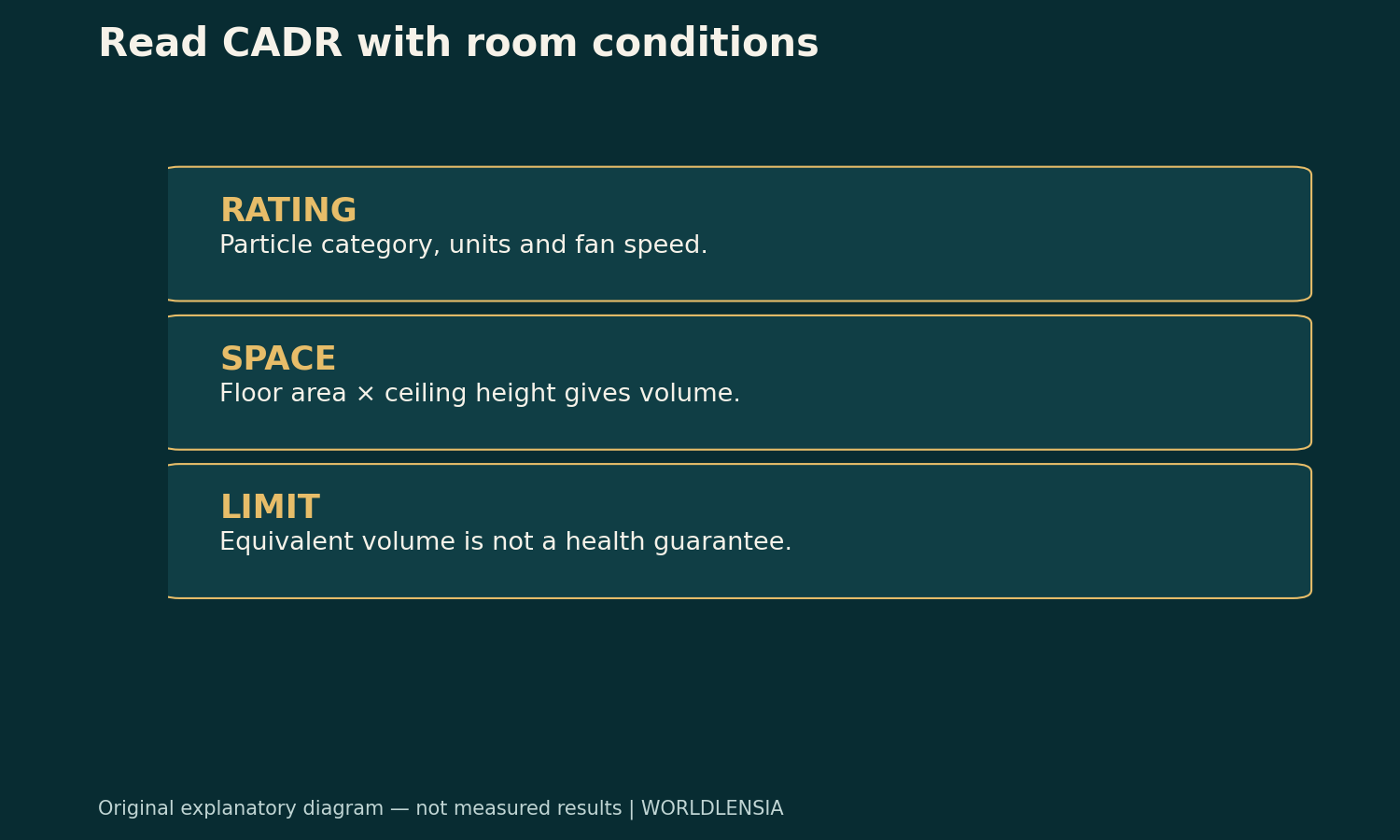
The US Environmental Protection Agency explains that a portable air cleaner should have a CADR appropriate for the room or area where it will be used. Its guidance also distinguishes particle-cleaning ratings from gas-removal performance and notes the importance of operating speed.
That distinction prevents a common overclaim. A particle CADR is not a universal rating for every airborne substance. A device's filter description, pollutant-specific claims and operating instructions need their own evidence.
Read which particle category is reported and whether the value refers to the highest fan speed. A specification measured in one mode does not automatically describe a quieter mode. The comparison should identify the setting people will actually use.
Convert area into volume
Floor area alone leaves out ceiling height. A 200-square-foot room with an eight-foot ceiling contains 1,600 cubic feet of air under a simple rectangular-room calculation. The same floor area with a twelve-foot ceiling contains 2,400 cubic feet.
That does not mean a room behaves like a perfectly mixed box. It means the geometric volume differs, so a comparison based only on floor area can hide a material assumption.
| Fictional room | Floor area | Ceiling height | Calculated volume |
|---|---|---|---|
| A | 200 sq ft | 8 ft | 1,600 cu ft |
| B | 200 sq ft | 12 ft | 2,400 cu ft |
These dimensions are invented teaching scenarios. Real rooms can have irregular shapes, open doorways and connected spaces that need additional consideration.
An idealized clean-air-equivalent calculation
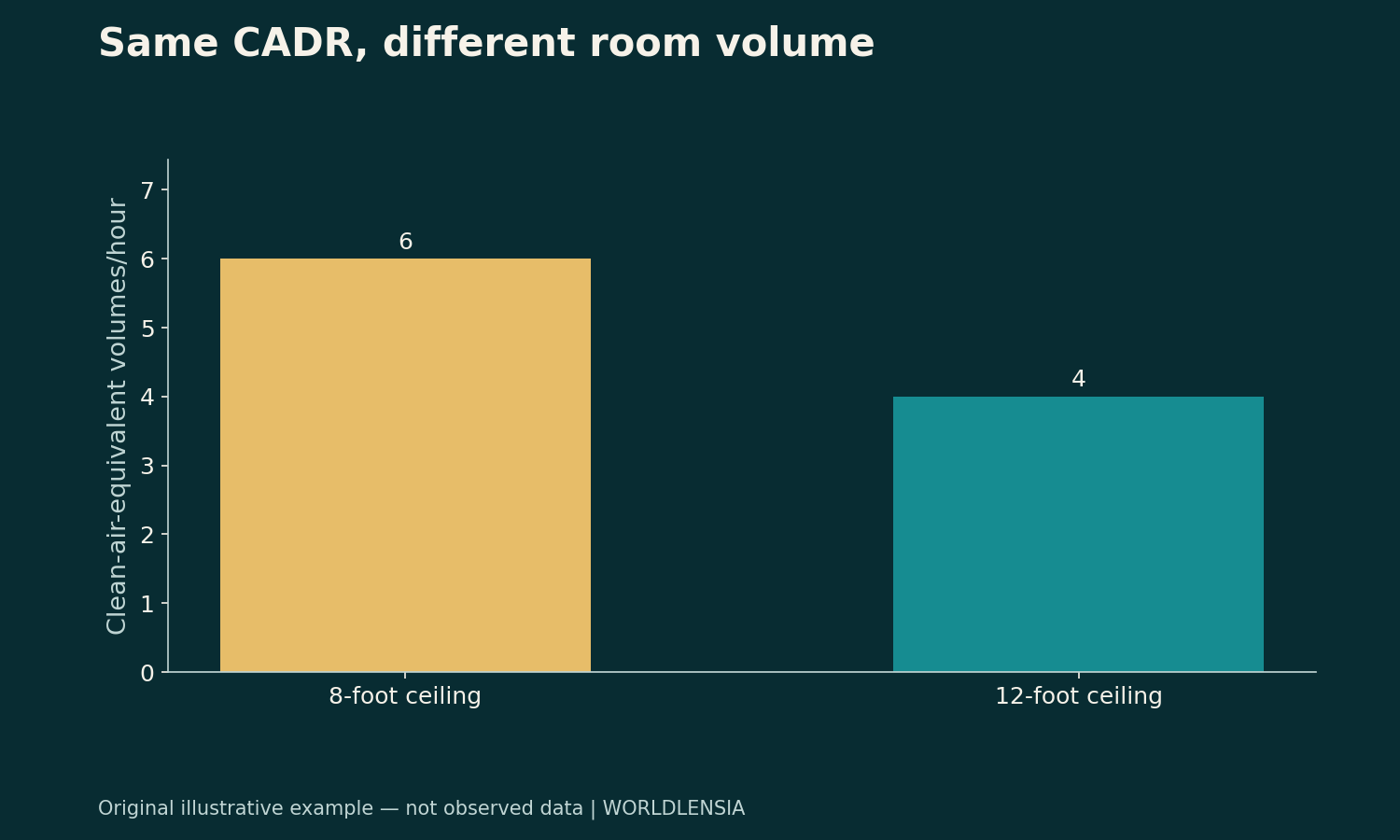
Suppose a fictional device has a particle CADR of 160 cubic feet per minute under the selected rating conditions. Multiply by 60 to obtain 9,600 cubic feet per hour. Divide by room volume to calculate a clean-air-equivalent number of room volumes per hour.
For room A, 9,600÷1,600=6. For room B, 9,600÷2,400=4. The same stated delivery produces different ratios because the room volumes differ.
These are equivalent-volume calculations, not counts of distinct parcels of air that pass through the machine once. Air mixes and can pass through repeatedly. The arithmetic does not establish an observed time to remove every particle or a guaranteed concentration in the room.
It also does not describe outdoor-air ventilation. Calling both quantities an “air change” without identifying the clean-air-equivalent basis can confuse filtration with replacement of room air by outside air.
Real operation adds conditions
A room can contain ongoing particle sources. Doors and windows can connect it with other spaces. Placement can affect how air reaches the device. The filter's condition and the fan setting can change operation. A rating is a defined comparison point, not a substitute for those conditions.
Follow the manufacturer's placement and maintenance instructions. Avoid blocking the inlet or outlet, and use the relevant replacement guidance rather than assuming performance remains identical forever. This article does not test a filter or estimate its remaining service life.
When comparing products, record whether the claimed room coverage assumes a particular ceiling height and operating speed. If the documentation does not state the basis, mark the gap rather than converting an unexplained area claim into a precise performance conclusion.
Particle removal and gas removal are separate
EPA's guidance states that the CADR rating system concerns particles. A claim about gases needs evidence about the relevant filter or technology and the substances involved. Do not infer that a high particle CADR proves equal effectiveness for every odor or gas.
Likewise, a filter-material label alone does not describe the complete device's room-level performance. Airflow, leakage, operating conditions and the rating method matter. Compare a complete stated capability with another complete capability, rather than mixing a material specification with a delivery measurement.
This is similar to the IP-rating guide: different exposures and test conditions need separate labels. A specification can be useful without becoming an all-purpose guarantee.
A comparison table that asks useful questions
For each device, record the exact model, particle CADR, units, fan setting, stated coverage assumptions and source date. Add noise information if quiet operation is part of the intended use, but do not assume the quietest mode retains the maximum rating.
Distinguish manufacturer statements from independent measurements. If a review reports a test, check the pollutant, room setup, instrument and duration. A result from a different method should not be silently treated as the manufacturer's CADR figure.
For a refurbished or used device, the electronics condition checklist offers a broader approach to verifying condition and support. Do not assume an attractive purchase price supplies missing evidence about filters or operation.
Keep the conclusion within the calculation
The fictional 160 cfm device corresponds to six clean-air-equivalent room volumes per hour in the simple 1,600-cubic-foot calculation. That is the supported arithmetic statement. It is not a prediction that a person will experience a particular health benefit or that all pollutants will disappear.
A useful product explainer preserves both parts: the rating can help compare particle-cleaning delivery, and the intended room and operating conditions remain part of the comparison.
A missing rating should remain missing
If a product lists a broad room-area claim but no compatible CADR or test basis, do not derive a precise rating from the marketing phrase. Record the missing information and seek the technical documentation. A comparison with an explicit gap is more useful than a complete table built from assumptions.
The same applies to a lower fan mode. Unless the source provides a mode-specific value or a verified test, the maximum rating should not be copied into every row of the comparison.
Preserve the source version
A revised specification or manual can change the comparison. Save the model identifier and the document date when available, and distinguish a current manufacturer statement from an older saved claim. Do not combine them silently.
The comparison remains conditional on those documented specifications.
Sources and methodology
CADR scope and room-sizing considerations were checked against the EPA Guide to Air Cleaners in the Home on October 19, 2026. A publication/update date was not established in the retrieved text. All room dimensions, the 160 cfm specification and equivalent-volume calculations are original hypothetical examples. No product testing, clinical benefit or gas-removal result is claimed.
To distinguish a room-sizing rating from other product specifications, see IP Ratings: Read Water and Dust Protection as Separate Claims and USB-C Cables: Check Charging, Data and Display Separately.