
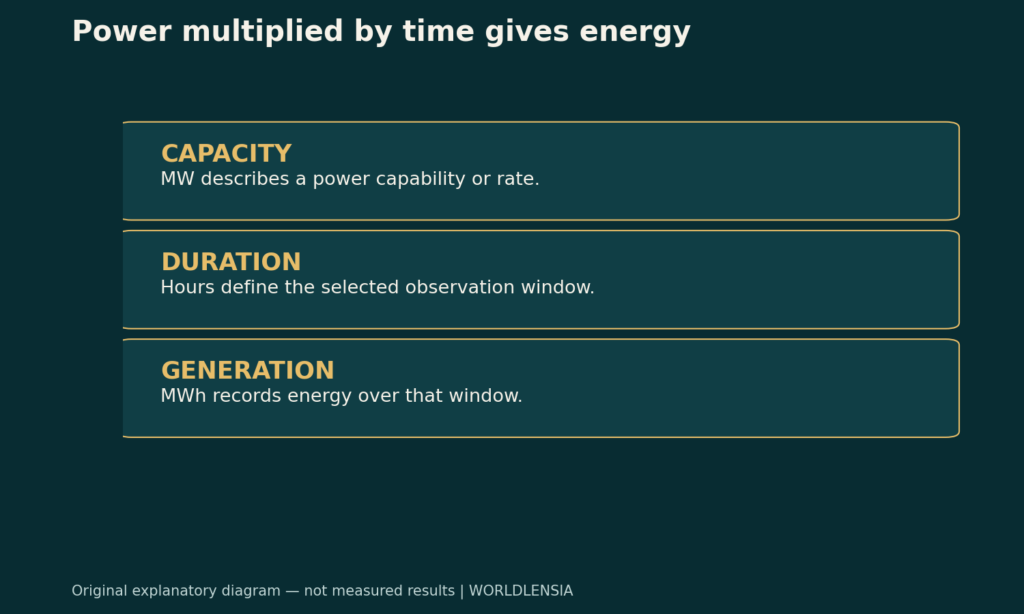
Electricity capacity and generation measure different quantities; a capacity figure does not show how much electricity a country produces over time. One describes a production rate under defined conditions; the other records energy produced over time.
The distinction is essential when reading energy announcements, comparing technologies or interpreting a national chart. A number in megawatts cannot be substituted directly for a number in megawatt-hours. Before discussing reliability, costs or environmental effects, establish what the numbers actually measure.
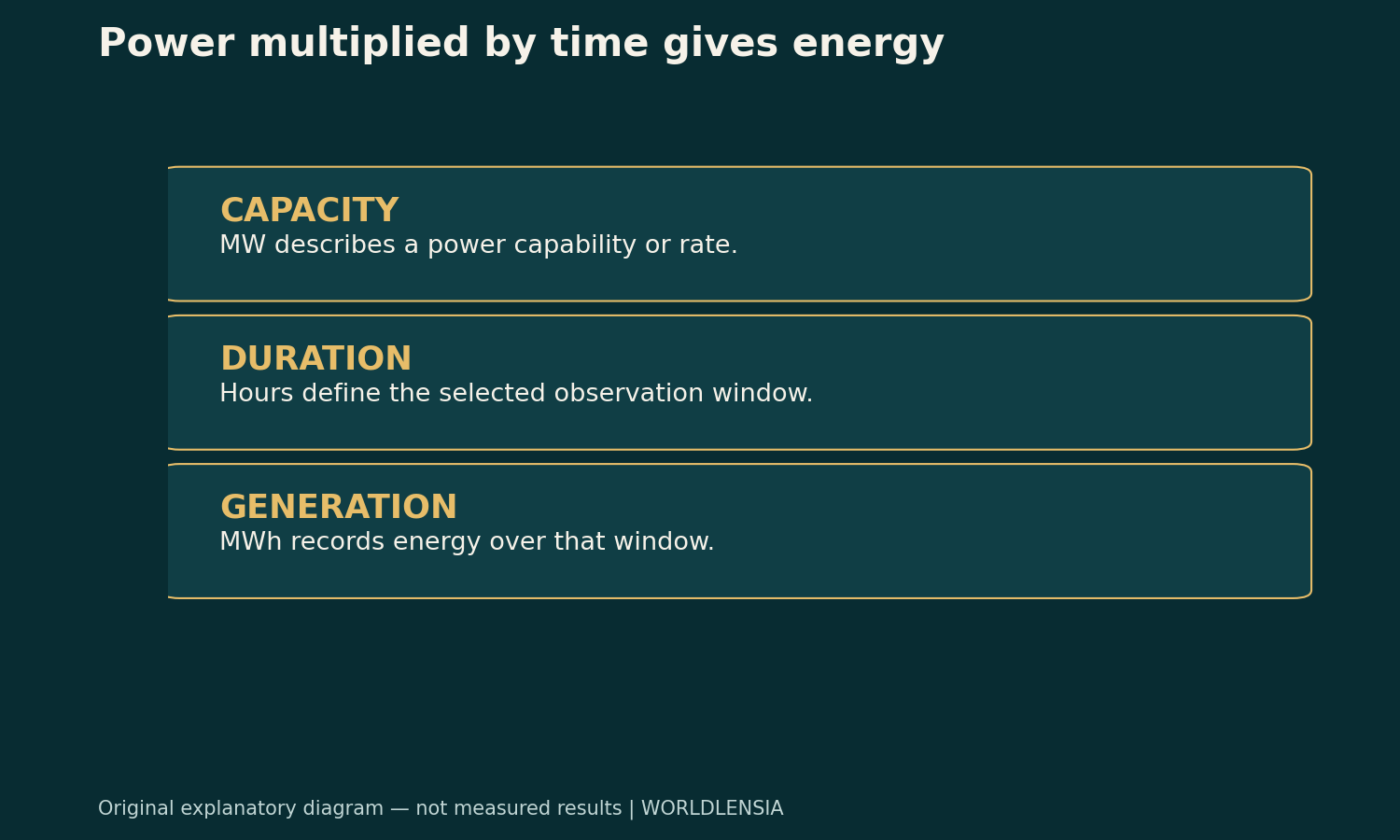
Electricity capacity and generation use different units
A watt is a unit of power. A megawatt is one million watts. A watt-hour is a unit of energy: power sustained over time. A megawatt-hour therefore combines a power quantity with a duration.
If a hypothetical installation produces one megawatt for one hour, it generates one megawatt-hour. Producing one megawatt for ten hours gives ten megawatt-hours. Producing ten megawatts for one hour also gives ten megawatt-hours, but the power profile is different.
EIA's capacity-versus-generation explanation supplies the official terminology behind the distinction. The calculations in this article are original teaching examples, not measurements of any real plant or country.
An illustrative annual account
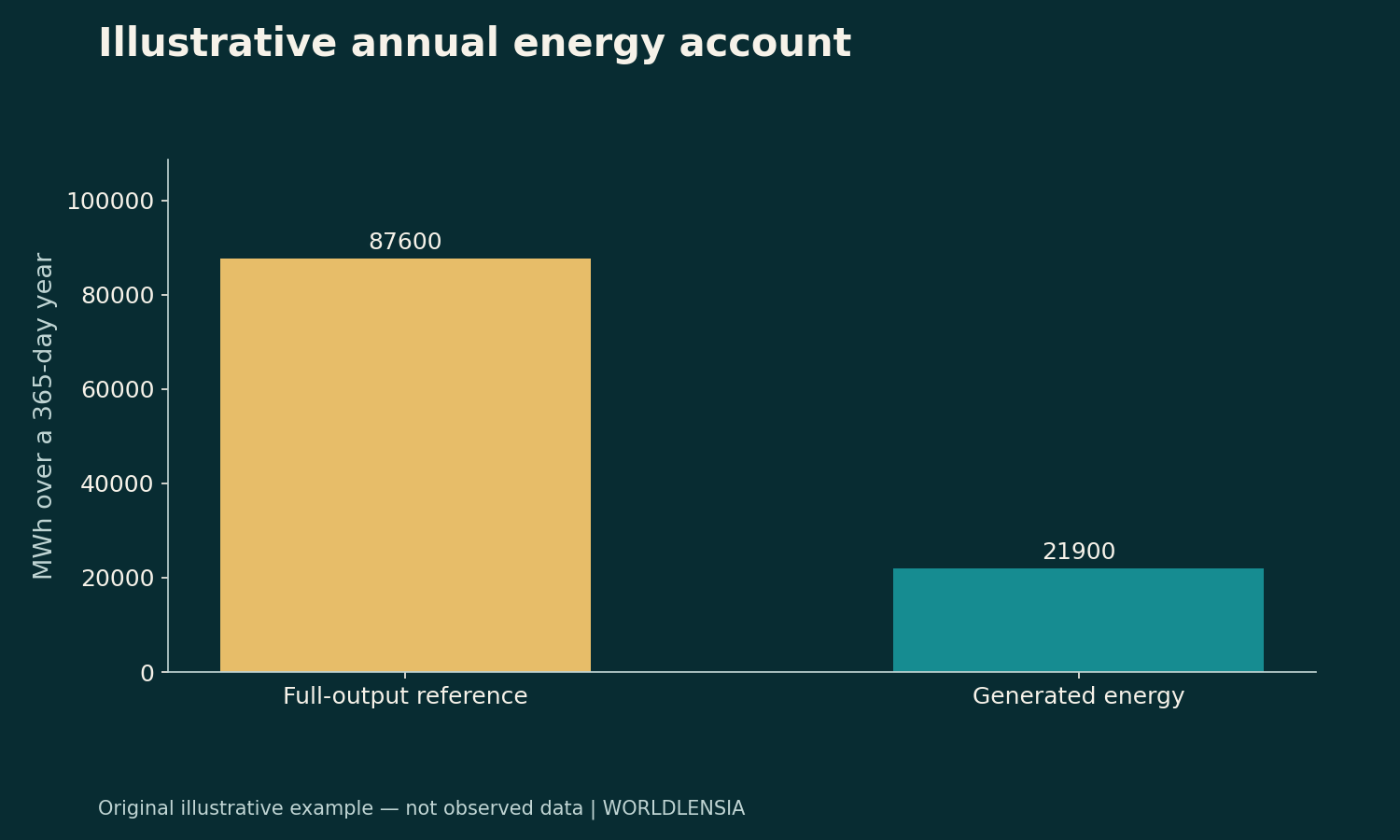
Consider a fictional installation with capacity of 10 MW. For a 365-day year, the number of hours is 365×24=8,760. Operating continuously at the stated 10 MW throughout that interval would correspond to 87,600 MWh.
Now suppose its measured annual generation in the fictional account is 21,900 MWh. Divide that energy by the 87,600 MWh reference to obtain 0.25, or a 25% capacity factor under this simple calculation.
| Synthetic item | Calculation | Result |
|---|---|---|
| Stated capacity | Given | 10 MW |
| Hours in the selected year | 365 × 24 | 8,760 hours |
| Full-output reference energy | 10 × 8,760 | 87,600 MWh |
| Fictional annual generation | Given | 21,900 MWh |
| Capacity factor | 21,900 ÷ 87,600 | 25% |
The calculation requires the selected period and the capacity basis. A leap year has a different number of hours. A facility whose capacity changes during the year may need a more careful account than one fixed annual nameplate figure.
A capacity factor is not a complete explanation
The 25% ratio describes energy relative to a reference, but it does not identify why generation took that value. Resource availability, outages, maintenance, dispatch decisions and other conditions can affect output. Which factors apply to a real installation requires operational evidence.
Avoid reading a single factor as a universal grade. Technologies perform different roles, and a facility may not be intended to generate at maximum output every hour. A comparison should identify the job and the constraints before deciding what the ratio implies.
Likewise, a high factor does not by itself establish low cost, low emissions or dependable output at a particular time. Those are additional questions with additional evidence requirements.
Timing matters even when annual energy matches
Two fictional systems could each produce 21,900 MWh over a year while supplying it at different times. One might have relatively steady output; another might concentrate generation in particular hours. Equal annual totals do not make their power profiles interchangeable.
If the question concerns meeting demand at a specific hour, inspect the relevant time profile and system conditions. An annual energy total cannot answer that hour-specific question on its own.
This is a units-and-aggregation issue, not a claim that one technology is always superior. Avoid using a hypothetical profile as though it were observed behavior for a real technology. State the actual data source and temporal resolution when making an empirical comparison.
Keep the capacity definition visible
Capacity labels can reflect different measurement bases. Read whether a source refers to a nameplate rating, an operational measure or another defined capability. Do not assume every series with “capacity” in its title uses identical conditions.
For an announcement, distinguish planned capacity from installed capacity and installed capacity from a verified operating status. A project proposal is not evidence of completed generation. Dates matter as well: a facility added late in a year has less time to contribute to that year's energy total.
A useful table separates announced, completed and operating quantities where the source provides them. If the status is unknown, keep it unknown rather than treating the largest announced figure as actual supply.
Country comparisons need matching boundaries
Check whether the generation total covers the same geography, sector and time period as the capacity total. A national system may include imports, exports, distributed generation or other components differently across datasets.
Do not add imported electricity to domestic generation without explaining the new measure. Do not compare a grid-only capacity series with an all-producer generation series as though the scopes were identical. Read the data notes before constructing the ratio.
Record gross or net generation if the source distinguishes them. A series definition can affect which energy uses are included. Similar labels do not eliminate the need for a scope check.
A larger capacity addition is not an energy forecast
Suppose a fictional announcement proposes another 10 MW installation. The capacity number alone does not establish that it will generate 21,900 MWh, 87,600 MWh or any other annual amount. That requires assumptions about operation, resource, timing and availability.
If an analyst creates a scenario, list those assumptions and label the result as modeled. Do not transfer the earlier 25% example automatically to the new project. The teaching calculation is not a technology-wide default.
The same caution applies to avoided emissions or fuel savings. Those calculations need information about what generation is displaced, when it is displaced and how the relevant system responds. Capacity arithmetic alone does not supply that evidence.
Compare the question before choosing the chart
For a capacity question, chart MW on a clearly labeled basis. For an energy question, chart MWh over a specified interval. If both are shown, use separate labeled panels rather than placing unlike units on one unexplained scale.
A capacity-factor chart needs the denominator method and period. A time-profile chart needs its interval and coverage. A country ranking needs compatible definitions and a warning when the scope differs.
WorldLensia's capacity-utilization guide makes a related point about naming the numerator and sustainable capacity. The water withdrawal-versus-consumption guide shows another resource comparison in which related quantities answer different questions.
Build a compact energy-data worksheet
Record the source, release date, observation period, geography, unit and definition for each series. Add the installation or system status and any exclusions. Keep raw values separate from the conversion and ratio calculations.
For the fictional example, the worksheet should show that 10 MW, 8,760 hours and 21,900 MWh are inputs with different meanings. The resulting 25% is a calculation. Any explanation of why it is 25% is a separate claim that needs separate evidence.
That structure makes a report easier to update and audit. If the generation value is revised or the capacity basis changes, the reader can see which result must be recalculated rather than treating the whole analysis as one indivisible number.
A careful conclusion
The fictional installation generated one quarter of the energy associated with continuous output at the stated capacity over the selected year. That is the narrow result. It does not establish a reliability rating, a cost comparison or an environmental outcome.
Electricity capacity tells you about a rate or capability. Generation tells you about energy over time. Keeping those roles visible is the starting point for every stronger claim built on them.
Check the period before calculating a factor
If a facility enters service halfway through the year, dividing its generation by a full-year reference based on year-end capacity can answer a different question from an operational-period factor. Neither denominator should be chosen silently.
For an actual series, follow the publisher's capacity and time conventions. If capacity changes during the period, a weighted or otherwise documented approach may be needed. Do not invent a single annual denominator from the largest capacity value in the file.
The same care applies to downtime. A factor based on calendar hours and a measure based on available operating hours describe different constructions. Keep the definition attached to the result rather than comparing them under one generic label.
Energy balances are not capacity totals
A country-level account may distinguish generation, imports, exports, storage and consumption under a stated framework. Adding power capacity to an energy balance is a unit error. Mixing generation with a demand total without reading the accounting rules can create another mismatch.
Use the official balance definitions when that is the question. If the article concerns only domestic generation, keep that boundary clear. A reader should not have to infer whether imported energy was included from a chart's title.
For storage, distinguish a power rating from an energy capacity. They answer different duration questions, just as generation capacity and annual energy do. Do not treat a single megawatt label as a complete description of how long a resource can deliver at that rate.
An announcement needs an implementation status
Record whether the stated project is proposed, approved, under construction, commissioned or operating according to the source. These are evidence statuses, not synonyms. A future completion date remains a plan until verified.
When writing about a capacity addition, avoid using the same verb for an announced intention and an observed operating change. A precise status sentence prevents readers from assuming that a future capability has already contributed to the measured generation total.
Avoid a silent unit conversion
A chart switching from MWh to GWh should divide values consistently and label the new scale. The physical energy has not changed. Retain the conversion in the calculation record so a later update cannot accidentally combine the two units in one column.
Sources and methodology
Definitions were checked against EIA's explanation of electric generation capacity and electricity generation on October 19, 2026. A publication/update date was not established in the retrieved page. All installation values, annual calculations and scenarios are original hypothetical teaching material. No current country statistic, technology forecast or investment recommendation is asserted.
To follow power and energy through devices and resource accounting, see Charger Watts vs Energy Use: Measure Input, Output and Time and Water Withdrawal vs Consumption: Read City Water Claims Carefully.