
Bookings describe a company’s defined measure of contracted business, billings describe invoiced amounts under a stated convention, and revenue reflects accounting recognition. Cash collection has its own date. The same customer contract can produce different values for all four during one reporting period.
These measures are useful when their definitions remain visible. Confusion begins when a signed contract is described as money earned immediately, an invoice is treated as cash received or a company’s custom bookings metric is compared with another’s without reconciliation.
Start with a simple service assumption
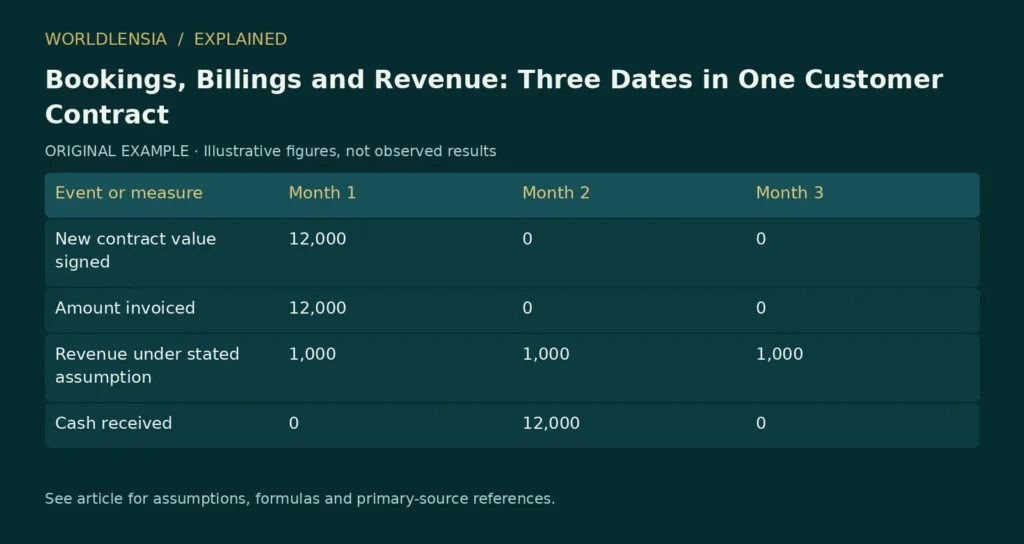
The example below is fictional. A customer signs a 12-month service contract for 12,000 currency units. Service is provided evenly over the year. The entire amount is invoiced at the start and paid one month later. Assume revenue is recognized evenly as the service is delivered, with no other performance obligations or complications.
Real revenue accounting can differ. FICO’s cited filing, for example, explains its own ACV bookings definition and describes recognition timing for certain software arrangements. [1] That disclosure illustrates why contract type and company policy matter; it should not be generalized to every subscription.
The SEC guide provides the broader distinction between revenues and cash flows. [2] The purpose of our simplified example is to show timing, not to prescribe accounting treatment for a particular business.
Follow the first three months
| Event or measure | Month 1 | Month 2 | Month 3 |
|---|---|---|---|
| New contract value signed | 12,000 | 0 | 0 |
| Amount invoiced | 12,000 | 0 | 0 |
| Revenue under stated assumption | 1,000 | 1,000 | 1,000 |
| Cash received | 0 | 12,000 | 0 |
Every row has a different purpose. Contract signing describes a commercial commitment under the assumed definition. Invoicing creates a request for payment. Revenue follows the fictional service-delivery pattern. Cash appears when payment arrives.
If a dashboard simply says “sales: 12,000,” the reader cannot tell which event it represents. A more useful dashboard labels the measure and its period explicitly.
Contract value and annualized bookings can differ
A company’s bookings metric may include total contract value, annual contract value, selected products, renewals, expected usage or other items. Some measures annualize multi-year contracts. Others estimate amounts not fixed at signing.
Suppose a fictional three-year agreement has total value of 36,000 with a flat annual pattern. A total-contract-value metric could record 36,000, while a simple annual-value metric could record 12,000. Both can describe the same agreement under different definitions.
The arithmetic is easy; the interpretation depends on the published policy. Do not assume “bookings” means total contract value unless the company says so. Record whether later modifications or cancellations revise the original measure.
Billings do not eliminate collection risk
An invoice can remain unpaid. If a business invoices 12,000 and collects only 9,000 during the relevant period, the gap requires explanation through receivables, timing or other accounting entries.
A rise in billings may also reflect a move from monthly to annual invoicing rather than faster customer growth. That can change cash timing and balance-sheet amounts without producing the same immediate change in recognized revenue.
Comparisons should therefore include payment terms. Two otherwise similar businesses can show different quarterly billings because one invoices in advance and the other after service. The difference is not automatically a difference in demand.
Revenue is not simply an arbitrary delay
Recognition follows the applicable accounting framework and the contract’s performance obligations. A simple straight-line service assumption is suitable for this teaching example, but actual software, hardware, implementation and usage arrangements can be more complex.
Read the revenue note before attempting to reconstruct an income statement from bookings. A transaction can include several components whose timing differs. The company’s explanation and the relevant professional accounting judgment are the appropriate basis for a real analysis.
Our article on returns and reporting dates explores another timing issue: later reversals and adjustments can affect the relationship between commercial activity and reported results.
Reconcile changes instead of choosing a favorite metric
If bookings rise while revenue growth slows, investigate contract duration, recognition timing, cancellations, product mix and delivery. If billings rise sharply, inspect invoicing terms and seasonal patterns. If cash lags billings, examine collection timing and credit exposure.
A strong analysis does not automatically dismiss one metric as useless or treat another as the only truth. Each describes a different stage. The task is to connect them under a consistent definition.
For a comparison worksheet, include the reporting period, measure name, definition, treatment of renewals, contract duration, currency effects and whether the figure is audited financial-statement information or a supplemental operating metric.
The practical benefit is a timeline that readers can follow. It explains why a company can sign substantial business today, invoice it now, collect payment next month and recognize revenue over a longer period, without any of those numbers necessarily contradicting the others.
Reconcile the fictional contract across its full term
The simple contract begins with a signed value of 12,000. Under the stated service assumption, twelve monthly revenue amounts of 1,000 sum to 12,000. The single invoice and single cash receipt also total 12,000 across the full term.
Equality across the entire simplified contract does not imply equality in each month. Month one has an invoice of 12,000, revenue of 1,000 and no cash receipt. Month two has revenue of 1,000 and cash of 12,000. The later months can have revenue with no new billing or receipt.
This is why comparing a monthly invoice report with a monthly income statement requires a bridge. The reports can both be correct while describing different events. A mismatch is a prompt to reconcile definitions and timing, not immediate evidence of an error.
The example assumes full collection and no modifications. If the customer does not pay, the analysis requires additional accounting treatment and a revised cash forecast. Do not use the clean teaching example to imply that every contract will be collected in full.
Change the billing schedule while holding service constant
Suppose the same fictional service is invoiced monthly instead of annually. It still has a 12,000 total signed value and, under the assumed delivery pattern, 1,000 of monthly revenue. But monthly invoices are now 1,000 instead of an initial 12,000.
If each invoice is paid a month later, the cash profile changes substantially. Upfront collection no longer supplies the same early funding. The business may need more cash to support service delivery before payments accumulate.
The customer relationship and total service price can remain the same while billings and cash timing change. A year-over-year jump in upfront invoicing can therefore create a large billings movement without the same movement in service delivered.
A comparison should identify whether payment terms changed. If the company offers a discount for annual payment, the contract value may change too; do not assume every term remains fixed unless that is part of the example.
A multi-year agreement needs more than one headline value
Consider a fictional three-year agreement with annual amounts of 10,000, 12,000 and 14,000. Total stated contract value is 36,000. A simple average annual value is 12,000, but the first year’s contractual amount is 10,000.
A company-defined annualized bookings metric might use a different method. Read the definition rather than applying the average automatically. The same agreement can produce several legitimate descriptive values, each answering a different question.
If a chart compares total contract value with annual recurring measures, it can make demand appear to jump merely because contract duration lengthened. Include duration and the metric’s policy in the explanation.
The example does not establish revenue recognition for that contract. Delivery obligations, contract terms and the accounting framework need separate analysis. Keep the arithmetic description of contract amounts apart from the recognition conclusion.
Separate renewals, expansions and new customers
Bookings growth can come from different commercial events. A renewal continues existing business, an expansion changes an existing customer’s commitment and a new-customer contract adds a new relationship under the company’s definition.
Suppose a fictional quarter records 100,000 of bookings: 60,000 renewals, 25,000 expansions and 15,000 new customers. The total describes contracted activity under the assumed definition, but it does not mean 100,000 came from new customers.
If the following quarter totals 110,000, inspect the components before saying acquisition accelerated. Renewals could have risen while new-customer bookings fell. A single total cannot identify the driver.
Definitions must remain consistent over time. If a company starts including renewals in a metric that previously excluded them, mark the break or use a comparable restated series. Do not treat a policy change as observed business growth.
Cancellations and modifications need a dated trail
A signed contract can later be reduced, expanded or canceled. The treatment of those changes in bookings depends on the company’s policy. Some measures revise earlier estimates; others record effects in a later period or disclose them separately.
For a fictional contract initially recorded at 12,000 and later reduced to 9,000, keep both the original booking and the modification date. Without that record, a recurring report may retain the original value while a revenue forecast uses the revised amount.
A reconciliation should explain where the 3,000 reduction appears. It should not silently delete the old record or count the revised 9,000 as a second new contract.
The same discipline applies to usage estimates. An estimated amount at signing is not identical to actual later usage. If a metric incorporates estimates, say so and avoid describing the full figure as a fixed payment obligation.
Keep the cash bridge separate from the revenue bridge
For the simplified annual invoice, a receivable can arise before payment. When cash arrives, the receivable changes, but that collection event does not automatically create a new service-delivery event.
Likewise, an advance payment can relate to future obligations. A complete accounting treatment depends on the contract and framework; the practical lesson is that each event must be recorded once in the appropriate account.
A useful internal reconciliation has stable contract identifiers linking signature, amendments, invoices, receipts and recognized revenue. It preserves dates and currencies rather than matching transactions only because their totals happen to be similar.
This helps detect duplicate invoices, missing receipts and inconsistent period assignment. It also gives an editor a way to verify a company-specific metric without guessing from the income statement alone.
Do not rank growth rates from incompatible bases
Suppose Company A reports growth in total contract value and Company B reports growth in annualized contract value. A shift toward longer contracts can affect A’s measure more strongly even if the underlying annual service commitments grow similarly.
Compare the definitions before comparing the percentages. Fiscal calendars, currency treatment, acquisitions and included products can also differ. An exact percentage is not a guarantee of conceptual comparability.
If no common basis is available, describe the measures separately. A statement that the two reported metrics are incompatible is more accurate than declaring one company the faster-growing business from those numbers alone.
For recurring coverage, preserve the original disclosure and note any later changes. A living investor-relations page can be updated, so a dated filing or release is often useful for version control.
Build a clear chart for mobile readers
The fictional contract can be shown as four short monthly rows: signed value, invoices, recognized revenue and receipts. Use currency units consistently and show zero values explicitly when zero is an assumed observation.
Do not draw a single line that jumps between these measures. That would combine different concepts into a series with no consistent meaning. A compact table is often clearer than a multi-axis chart.
The caption should identify the even-service assumption, full upfront invoice and one-month payment delay. Those conditions explain the shape. Without them, the chart could look like an observed company result rather than an original teaching example.
End with a reconciled statement
A useful financial summary can say that the company signed a specified amount of business under its bookings policy, invoiced another amount, recognized revenue under its accounting policy and collected a separately identified amount of cash.
Where evidence is missing, leave the link uncertain. Do not invent a collection rate or delivery schedule to make the story feel complete.
The value of these metrics lies in their connection. A clear contract timeline explains how commercial commitments become obligations, invoices, performance and receipts. That is a stronger account of business activity than choosing whichever number happens to be largest in the current period.
Keep the event date and reporting period distinct
A contract signed near a quarter-end, an invoice dated the following week and a later receipt can fall in three different reporting periods. Verify the relevant event dates before explaining a mismatch. The period in a dashboard may refer to signing, invoicing, service or payment depending on the report.
A stable contract identifier helps connect those events without forcing them into the same month. For a recurring article, preserve the company’s disclosed period convention and any cutoff changes. If the source does not explain a convention, mark it as unknown rather than assuming it matches another company.
This date discipline also prevents accidental duplication when an invoice or contract is amended. The amendment should be linked to the original event and treated under the stated policy, not automatically counted as an independent new sale.
Sources and method
- FICO June 2026 filing, ACV bookings and revenue notes. Quarter ended June 30, 2026. Checked October 20, 2026.
- SEC financial statement guide. Published February 4, 2007; reviewed February 5, 2007. Checked October 20, 2026.
Numerical teaching examples are original and illustrative unless explicitly identified otherwise. No hands-on product testing or individual medical assessment is claimed.
To connect contract events with backlog and working capital, see Business Backlog: Future Work Is Not the Same as Earned Revenue and Cash Conversion Cycle: Why Growth Can Tie Up Cash.