
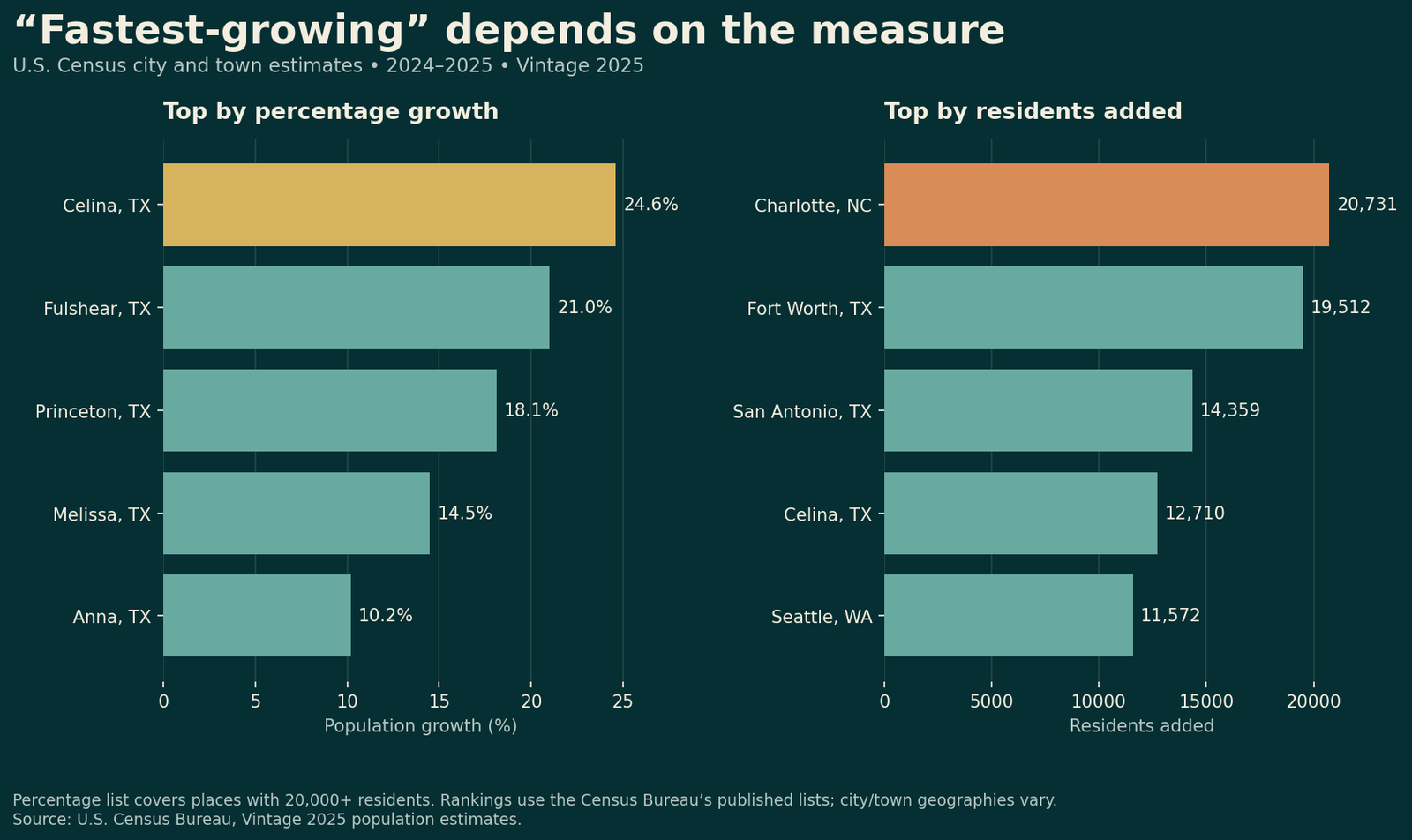
The fastest-growing US cities by percentage in 2025 depend on what “fastest” means. By percentage growth, Celina, Texas, led cities and towns with at least 20,000 residents, rising 24.6%. By the number of people added, Charlotte, North Carolina, ranked first, gaining 20,731 residents. These are different rankings, and each answers a different question.
This guide compares both measures using the U.S. Census Bureau’s Vintage 2025 population estimates for July 1, 2024, to July 1, 2025. The data are the latest annual city and town estimates available in this release, published May 14, 2026.
Fastest-growing US cities by percentage in 2025
The Census Bureau’s top 15 list covers cities and towns with populations of 20,000 or more. Its percentage ranking compares each place’s growth with its own starting population. Eight of the 15 places are in Texas, including all five leaders. In this release, the fastest-growing US cities are ranked by percentage change, so a smaller population base can produce a higher rate.
| Rank | City or town | State | Population growth | 2025 population |
|---|---|---|---|---|
| 1 | Celina | Texas | 24.6% | 64,427 |
| 2 | Fulshear | Texas | 21.0% | 64,630 |
| 3 | Princeton | Texas | 18.1% | 43,524 |
| 4 | Melissa | Texas | 14.5% | 29,969 |
| 5 | Anna | Texas | 10.2% | 35,245 |
| 6 | Haines City | Florida | 10.0% | 45,973 |
| 7 | Waukee | Iowa | 9.3% | 34,890 |
| 8 | Forney | Texas | 8.5% | 41,658 |
| 9 | Eagle Mountain | Utah | 8.5% | 66,557 |
| 10 | Johnstown | Colorado | 8.4% | 22,433 |
| 11 | Kuna | Idaho | 8.4% | 31,525 |
| 12 | Queen Creek | Arizona | 8.2% | 89,770 |
| 13 | Hutto | Texas | 7.9% | 46,048 |
| 14 | Foley | Alabama | 7.8% | 30,354 |
| 15 | Greenville | Texas | 7.5% | 37,069 |
Source: U.S. Census Bureau, Vintage 2025 population estimates. Percentages and populations are reproduced from the Bureau’s published table.
U.S. cities that added the most residents
A percentage rate can put a smaller place at the top because the increase is measured against a smaller population base. The numeric-growth list shows which cities added the most residents, regardless of their starting size.
| Rank | City | State | Residents added | 2025 population |
|---|---|---|---|---|
| 1 | Charlotte | North Carolina | 20,731 | 964,784 |
| 2 | Fort Worth | Texas | 19,512 | 1,028,117 |
| 3 | San Antonio | Texas | 14,359 | 1,548,422 |
| 4 | Celina | Texas | 12,710 | 64,427 |
| 5 | Seattle | Washington | 11,572 | 784,777 |
| 6 | Houston | Texas | 11,515 | 2,397,315 |
| 7 | Fulshear | Texas | 11,196 | 64,630 |
| 8 | Nashville-Davidson balance | Tennessee | 9,244 | 721,074 |
| 9 | Port St. Lucie | Florida | 9,131 | 268,062 |
| 10 | McKinney | Texas | 8,504 | 236,001 |
| 11 | Atlanta | Georgia | 8,350 | 529,110 |
| 12 | Jacksonville | Florida | 8,319 | 1,017,689 |
| 13 | Surprise | Arizona | 7,702 | 175,304 |
| 14 | Columbus | Ohio | 7,696 | 938,396 |
| 15 | Goodyear | Arizona | 7,690 | 125,359 |
Source: U.S. Census Bureau, Vintage 2025 population estimates. Nashville-Davidson refers to the balance of the consolidated metropolitan government, as defined in the Census table.
What the two rankings show
When people search for the fastest-growing US cities, it helps to check whether the ranking measures percentage growth or the number of people added.
- Celina ranks highly on both measures. It ranked first by percentage growth and fourth by number of residents added.
- Charlotte leads by numeric increase. It added 20,731 people, even though its percentage growth was not high enough to put it in the top 15 percentage list for places of 20,000 or more.
- Texas dominates the percentage leaders. The top five and eight of the top 15 were Texas places. The 15 fastest-growing list also includes places in Florida, Iowa, Utah, Colorado, Idaho, Arizona and Alabama.
- A city and its metro area can tell different stories. City limits exclude surrounding suburbs. A metro-area ranking uses a wider geography, so check which boundary a source is measuring before comparing rankings.
How to interpret the Census numbers
“Population growth” here means the Census Bureau’s estimated change in the resident population between July 1, 2024, and July 1, 2025. The first table ranks by the Bureau’s published percentage increase; the second reproduces its separate numeric-increase ranking. A place can rank high on one measure and lower on the other because its population base differs.
The release covers local governmental units, including incorporated places such as cities and towns, minor civil divisions such as townships, and consolidated cities. Therefore, “city” in a casual headline may not mean the same geography in every dataset. This table follows the Census Bureau’s own labels and rankings rather than mixing city boundaries with metro areas.
Fastest-growing US cities are not necessarily the fastest-growing metro areas, because city limits and metro boundaries cover different populations. Census revises estimates back to the last decennial census when it issues a new vintage. For a valid year-to-year comparison, use figures from the same vintage. Do not combine an older vintage’s 2024 estimate with a newer vintage’s 2025 estimate and present the result as a consistent series.
Download the city-growth comparison workbook
Download the free city-growth comparison workbook (Excel, 9 KB) to inspect the two published top-15 lists side by side. The workbook includes source notes, starting-population calculations for the numeric-gain list, and lookups showing which of those places also appear among the percentage leaders.
It uses Census Vintage 2025 figures for July 1, 2024–July 1, 2025 and preserves the 20,000-resident starting threshold. Reported ranks are kept separate from derived arithmetic; an “outside top 15” label is not an exact national rank. Prepared by WorldLensia with AI assistance; the linked Census release remains the primary source.
Method and source
We used the Census Bureau’s Vintage 2025 city and town population estimates, released May 14, 2026. The annual comparison is July 1, 2024, to July 1, 2025. The percentage-growth table is limited to the Bureau’s top 15 fastest-growing US cities and towns with populations of at least 20,000; the numeric-growth table follows the Bureau’s separate top 15 ranking. We did not calculate rankings from rounded percentages or mix vintages.
For more context, explore our Countries & Cities research.
Frequently asked questions
What was the fastest-growing U.S. city in 2025?
Among U.S. cities and towns with populations of 20,000 or more, Celina, Texas, ranked first by percentage growth, increasing 24.6% to 64,427 residents between July 2024 and July 2025.
Which U.S. city added the most people in 2025?
Charlotte, North Carolina, had the largest numeric increase in the Census Bureau’s table, adding 20,731 residents and reaching 964,784.
Why are percentage growth and population gain different?
Percentage growth compares the increase with the starting population. Numeric growth counts the additional residents. A smaller city can grow faster by percentage while a larger city adds more people overall.
City growth rates can change when boundaries, population density, or comparison groups differ. See our guides to why city rankings reverse when comparisons change and how population density depends on boundaries and weighting.
Keep the comparison clear: Our city-growth comparison card pairs a labeled fictional example with six checks for sharing population rankings accurately.
To separate the city ranking from demographic components and density, see Net Migration vs Population Growth: Account for Inflows and Outflows.